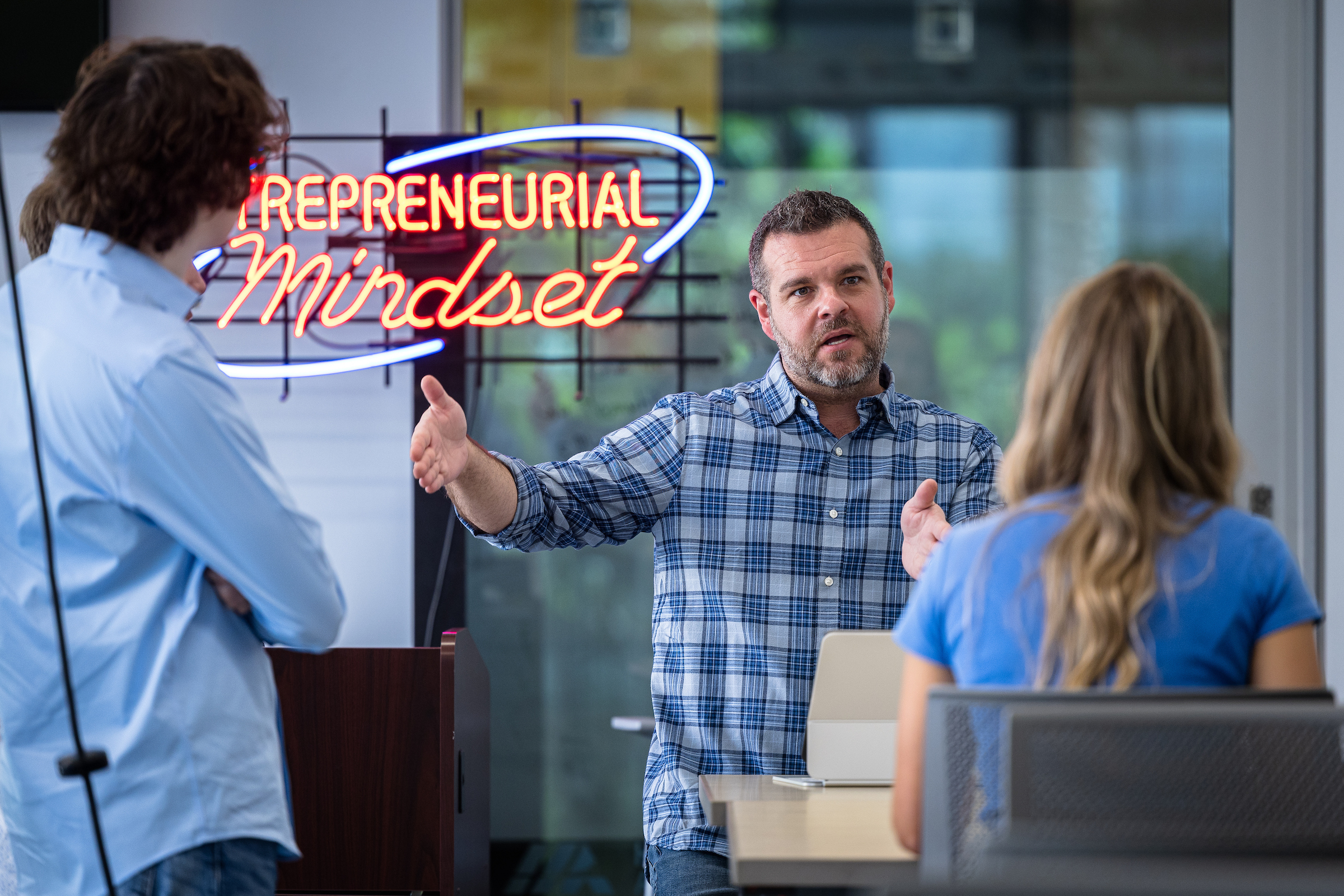
Students from Arizona State University are assisting local businesses in implementing artificial intelligence to enhance their operations, guided by Christopher Myers, an instructor at the W. P. Carey School of Business and founder of the AI consulting firm Main & Machine.
Student-Driven AI Initiatives
Main & Machine, founded by ASU alumnus Myers, collaborates with small and midsize businesses to identify repetitive tasks and create AI-driven solutions. This partnership has brought together ASU students from various disciplines to work directly with business owners facing challenges in their operations.
Among the clients benefiting from this initiative are a collector car shop and a seafood restaurant. Joe Ritz, co-owner of the Sports & Collector Car Center, initially hesitant about incorporating AI into his business, found inspiration through his daughter’s experiences in data processing for pediatric cancer research. This prompted him to consider how technology could streamline the tracking of essential car details.
Transforming Traditional Practices
Myers emphasizes the importance of understanding current business operations while envisioning improvements with AI. His students are pivotal in this process, analyzing workflows and suggesting practical applications of technology.
At the Sports & Collector Car Center, students are helping to implement systems that could save time and enhance efficiency in tasks such as tracking production numbers and specifications. Experienced mechanics, like Brian Doyle, acknowledge the importance of human oversight to complement the AI solutions, ensuring that nuanced decisions are made based on experience.
Enhancing Efficiency in Dining
In a different context, Frankie Chen, operations director for Krazy Cajun Seafood, is also exploring AI applications. His restaurant employs a service robot to deliver food, and now his team is considering a system to improve inventory management, which currently consumes significant employee hours each week.
The proposed AI system aims to streamline the ordering process by automatically scanning invoices and tracking ingredient quantities. This would help reduce unnecessary purchases and minimize food waste, allowing managers to focus on food quality and customer engagement.
Future Prospects
Students like Alex Kester and Ashley Waples are eager to contribute to these developments, recognizing the potential for AI to transform both the car restoration business and the restaurant industry. They believe that improved systems will enable business owners to dedicate more time to customer interactions and service quality.
As these projects evolve, both Ritz and Chen anticipate that AI will not only enhance operational efficiency but also allow their businesses to grow by freeing up time for more valuable customer engagement.
Source: Arizona State University