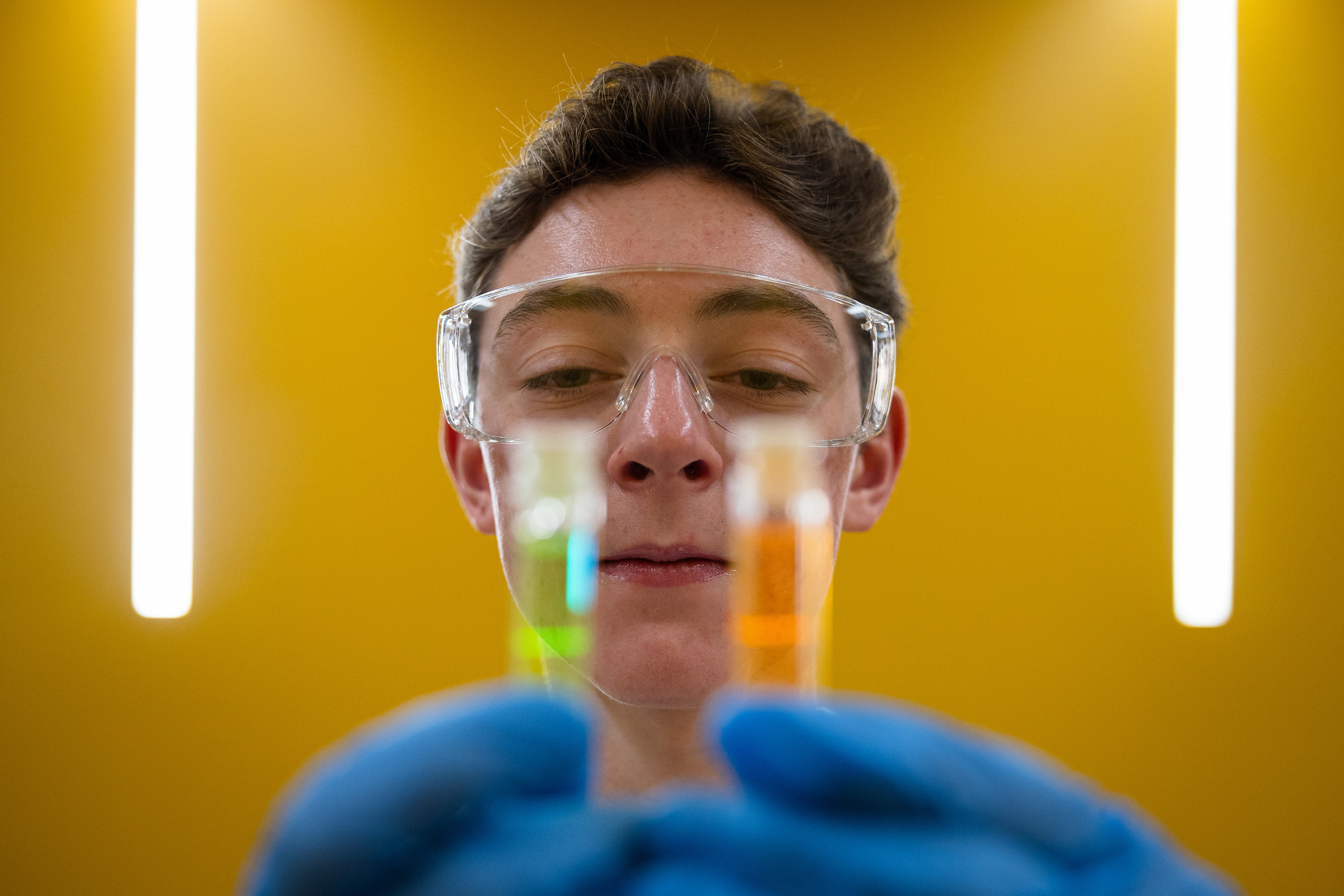
Ethan Friedman, a 16-year-old student, is conducting research at Arizona State University to explore how ocean pollution may impact the light that reaches coral and other marine life. Under the guidance of Assistant Professor Justin Earley, Friedman is focusing on the effects of pollutants in the ocean’s surface microlayer.
Research Focus on Light and Coral
Friedman began his journey in scientific inquiry at the age of 15 when he reached out to Earley, a quantum chemist in ASU’s School of Molecular Sciences. Now a junior at ASU’s Gary K. Herberger Young Scholars Academy, he is investigating how pollutants like oil and soot can form films on the ocean’s surface, potentially altering the light wavelengths that marine organisms rely on for reproduction and other vital processes.
Coral reefs engage in synchronized reproductive events, releasing millions of eggs and sperm guided by environmental signals, including the moonlight. Friedman’s research aims to determine how surface pollutants could disrupt this natural light, affecting coral reproduction and other marine life.
Methodology and Techniques
To conduct his research, Friedman has set up an experiment utilizing ultraviolet-visible spectroscopy. This technique allows him to measure how different pollutants affect the transmission of light through water at various angles. Although the research is in its early stages, Friedman is hopeful that it will provide insights into the relationship between ocean pollution and light dynamics.
“This particular area felt very impactful,” Friedman noted, emphasizing the personal significance of his work in understanding environmental challenges.
A Journey of Curiosity and Learning
Friedman’s passion for science began at a young age, prompting him to seek out academic challenges and mentorship. After joining Earley’s lab, he designed an educational project on quantum confinement and developed an understanding of spectroscopy, which he is now applying in his ocean research.
Earley expressed admiration for Friedman’s enthusiasm and potential, recalling his own experiences with mentorship during his undergraduate studies. He aims to provide Friedman with an environment that fosters curiosity and independent thinking.
Both Friedman and Earley acknowledge that research often involves unexpected challenges. They emphasize the importance of learning from setbacks and remaining open to discovery, even when experiments do not yield anticipated results.
Source: Arizona State University