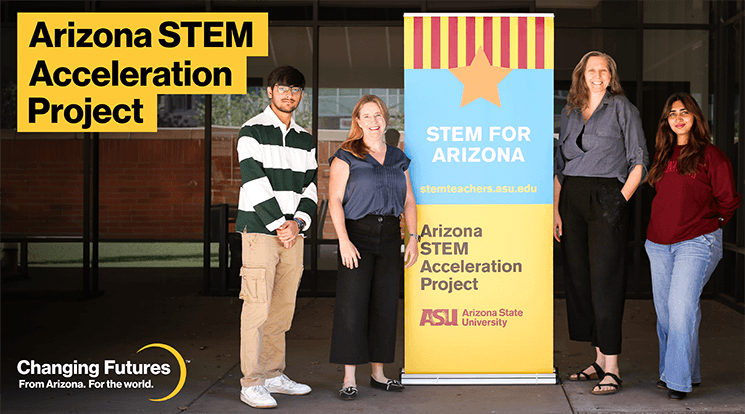
As Arizona faces a growing demand for STEM professionals, a new initiative is enhancing the skills of K–12 educators to improve science and math education statewide. The Arizona STEM Acceleration Project (ASAP), guided by Arizona State University (ASU), has reached over 247,000 students and is set to expand further with recent funding.
Funding and Expansion
ASAP recently secured $200,000 from the APS Foundation to support 100 STEM Teacher Fellows. Additionally, a $600,000 grant from the U.S. Department of the Navy’s Office of Naval Research will facilitate three years of professional development focused on naval science and technology. These funds build on a previous $10 million investment from the Arizona Department of Education, which supported more than 900 teacher fellowships since the project’s inception in 2022.
The initiative aims to address the increasing need for skilled workers in Arizona’s semiconductor, aerospace, and advanced manufacturing sectors, which are rapidly evolving. The Mary Lou Fulton College’s Center on Reinventing Public Education has noted the necessity for more educators to effectively teach math.
Professional Development Opportunities
Ruth Wylie, a research professor and co-principal investigator for ASAP, emphasized the positive impact of the initiative on educators. The APS Foundation grant, which is active through May 2027, will provide stipends and professional development opportunities for teacher fellows, who will also create transdisciplinary STEM lessons to be added to ASAP’s online resource archive.
With over 2,000 standards-aligned lessons available, teachers and parents can access engaging STEM instructional plans at no cost. Amanda Whitehurst, another co-principal investigator, highlighted the wealth of resources being developed through the program.
Impact on Educators and Students
Educators participating in the program have reported enhanced teaching methods and increased student engagement. Amanda Sibley, a science educator, noted how her experience with the initiative inspired her to create innovative lesson plans, such as one exploring Newton’s second law through skiing physics using LEGO bricks.
Feedback from participants indicates that the collaboration fostered by ASAP is critical to enriching classroom experiences. Elementary teacher Kim Alvin De Lara remarked on the value of networking with other educators and STEM professionals, stating that it has enhanced her ability to incorporate current practices into her teaching.
Building a Collaborative Network
As Arizona’s STEM landscape continues to evolve, sustaining collaboration among educators, universities, and industry partners will be crucial. Wylie believes that the resources created by teachers through this initiative can benefit educators and students statewide, leveraging the collective knowledge of the teaching community.
By connecting teachers with professional learning opportunities and fostering a network of support, ASAP aims to strengthen STEM education across Arizona, potentially serving as a model for similar efforts nationwide.
Source: Arizona State University