Massive star produces outbursts

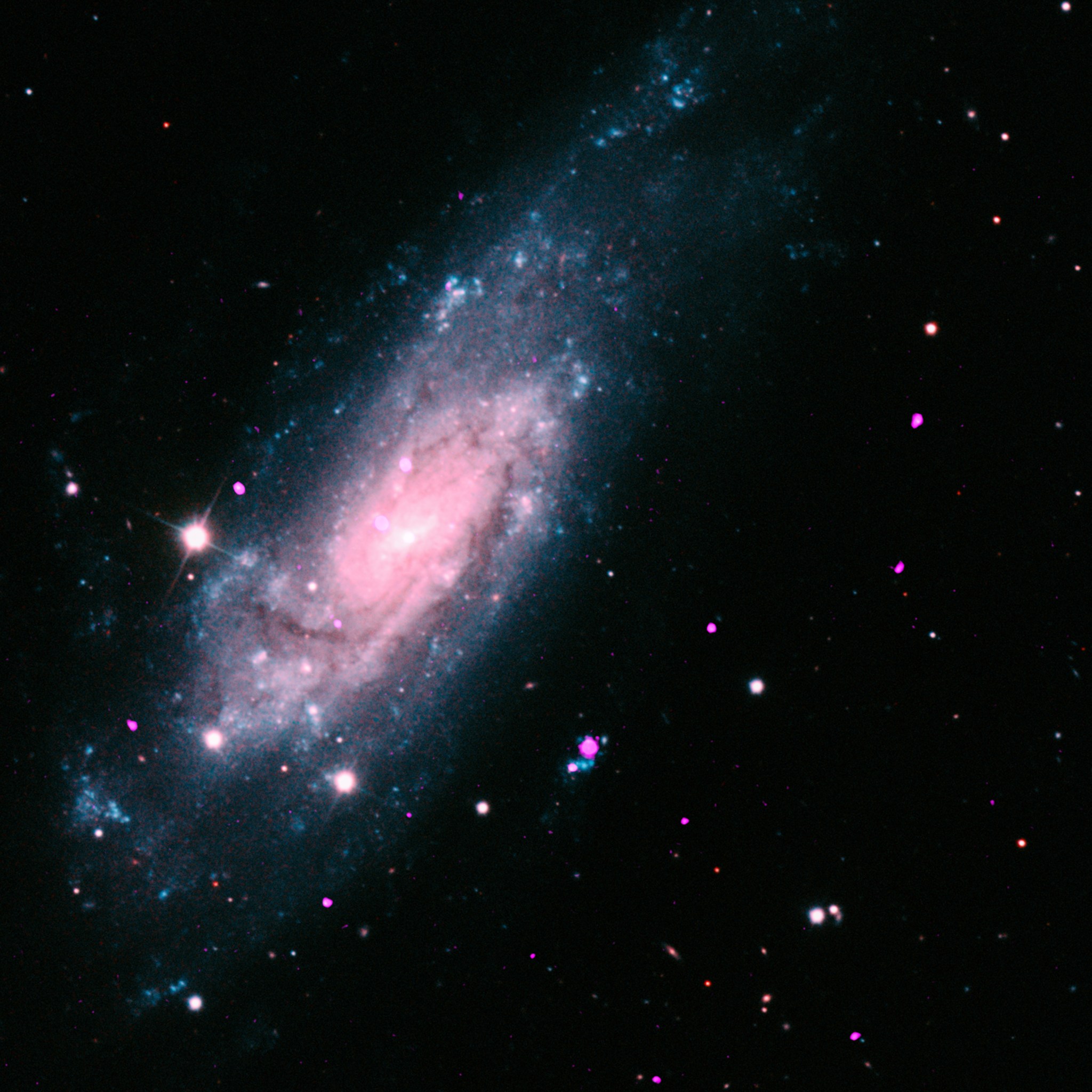
This release features a composite image of a spiral galaxy with a giant, unstable star at its outer edge. Using Chandra, astronomers have discovered the star’s previously hidden companion, which triggers luminous outbursts every 113 days. The spiral galaxy is NGC 4559. Shown at a sharp angle in the composite image, its flat pink and milky blue face tilts toward our upper left. Sitting near the outer edge of the dense spiral, near the center of the frame, is a small group of pink and blue dots. This group is outlined with a white square, enlarged and annotated in supporting images. The smallest pink dot in the square is AT 2016blu, a massive star some 33 times the size of our Sun. For over 15 years astronomers have been watching this star get bright and then dim again in optical light on a regular basis. Chandra’s X-ray observations suggest that a hidden companion object, either a stellar mass black hole or a neutron star, is pulling material from AT 2016blu every 113 days as they orbit one another. This captured material gets so hot that it shines brightly in X-rays. Other pink and blue specks within the white square and enlargement are unresolved stars or star clusters, too distant to be related to the movement of material between AT 2016blu and its hidden but influential neighbor.

Astronomers using NASA’s Chandra X-ray Observatory have identified the cause of repeated outbursts from a massive star in the spiral galaxy NGC 4559, located approximately 30 million light-years from Earth. The findings were announced on November 9, 2026.

Characteristics of the Star

The star, designated AT 2016blu, is characterized as unstable and has an estimated mass of at least 33 times that of the Sun. This significant mass contributes to its volatile behavior, which has captured the attention of researchers.

Ongoing Research

This discovery adds to the understanding of massive stars and their life cycles, particularly how instability leads to explosive events. The research continues to shed light on the mechanisms behind such stellar phenomena.

Source: NASA