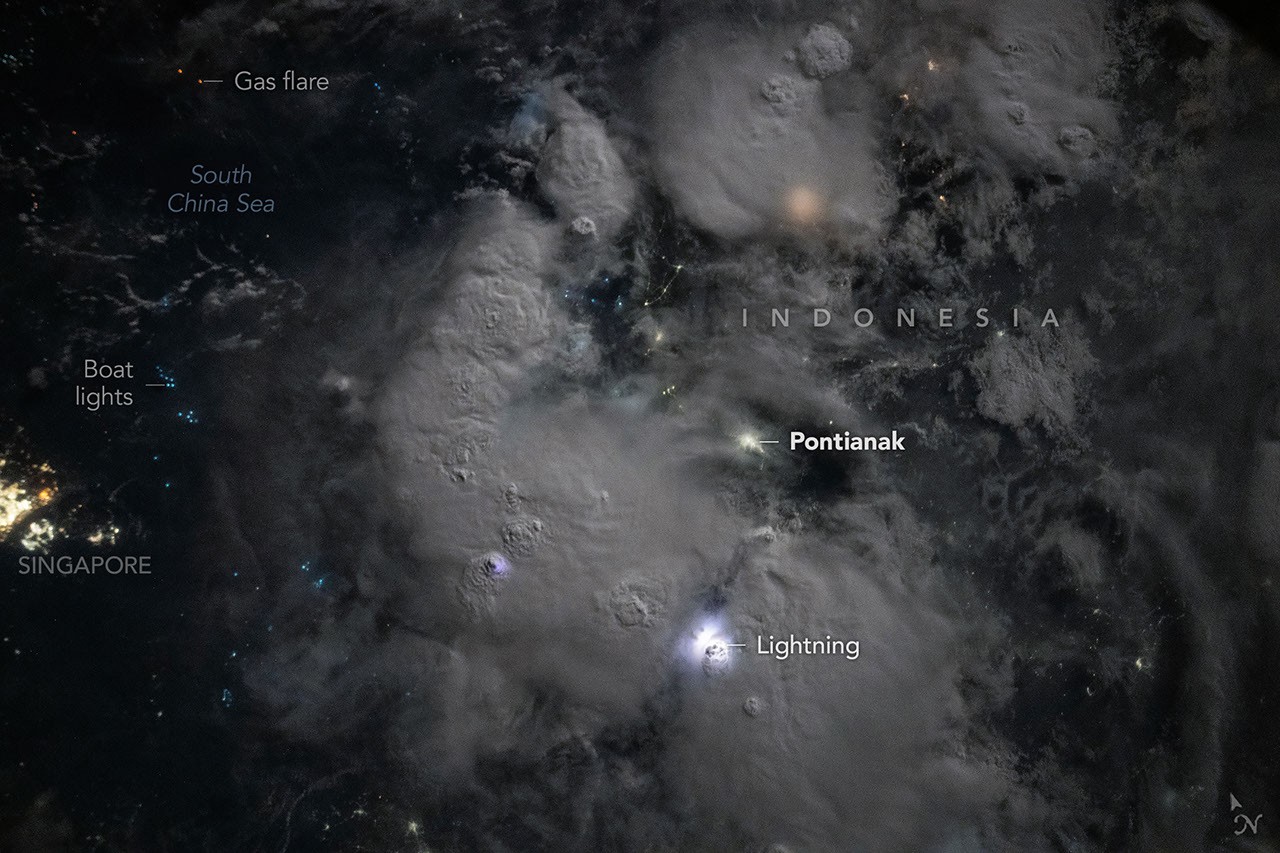
NASA astronauts aboard the International Space Station recently captured stunning views of Earth at night, showcasing the vibrant lights of cities, fishing boats, and lightning. On October 28, 2026, the station passed over the South China Sea, allowing for a unique perspective on these phenomena.
Astronaut Perspectives on Earth’s Nightscape
In an essay for Air & Space magazine, NASA astronaut Donald Pettit described the breathtaking sight of Earth from space, likening city lights to “tendrils outlined with the glimmer of a Broadway marquee.” He noted that clusters of fishing boats illuminated the dark ocean, resembling a constellation. Similarly, Sally Ride, the first American woman in space, highlighted the beauty of lightning viewed from orbit, noting that from above the clouds, it transforms into bursting balls of light.
Notable Visuals from the Space Station
During the October 28 flyover, astronauts observed several overshooting tops from thunderstorms, which are indicative of strong updrafts. The lights of Singapore, with a population of 6.2 million, appeared prominently in the image, separated from neighboring islands by the Singapore Strait. The blue lights seen to the west were likely from fishing boats using bright lights to attract marine life, while scattered orange points in the northwest were probably gas flares.
Lightning: A Favorite Among Astronauts
Lightning captures the interest of many astronauts. Anil Menon, another NASA astronaut, referred to lightning as “my favorite sight from space,” describing it as reminiscent of fireflies in the night. He emphasized the challenge of capturing lightning in images, but noted that a recent video demonstrated the extensive reach of storm activity across the planet.
Thunderstorm Activity on Earth
NASA scientists estimate that approximately 2,000 thunderstorms are active on Earth at any given moment, producing nearly 60 flashes of lightning per second, which totals around 5 million flashes daily. The captivating images taken from the International Space Station serve to highlight the dynamic and beautiful aspects of our planet from a distinct vantage point.
The photograph, taken with a Nikon Z9 camera, was acquired during this observation and is a part of a project aimed at providing valuable imagery for both scientific and public use. The International Space Station Program supports this initiative as part of its efforts to foster appreciation for Earth’s beauty and complexity.
Source: NASA