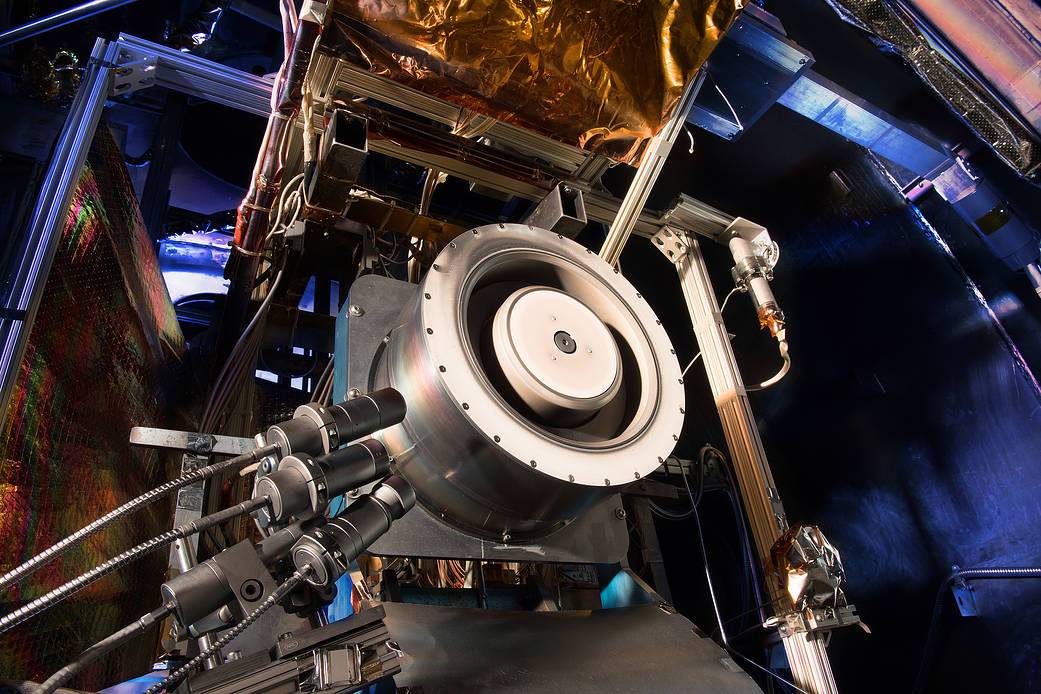
NASA has announced a new competition aimed at encouraging U.S. companies to develop prototypes of mid-power Hall effect thrusters, which are vital for future space operations and exploration. This initiative is part of the agency’s Advanced Mid-Power Electric Rocket (AMPERE) Challenge, which offers a total of $500,000 in prize money for innovative solutions in electric propulsion technology.
Hall effect thrusters utilize an electric field to accelerate a propellant gas, providing efficient thrust for long-duration missions. They are currently employed in satellite propulsion and deep space robotic vehicles, making them essential for advancing space exploration capabilities.
The AMPERE Challenge aims to advance mid-power systems that could serve as a foundation for upcoming NASA and commercial missions. According to Dr. Jason Frieman, a project co-owner at NASA’s Glenn Research Center, the competition’s goal is to eliminate barriers to commercialization by granting winners access to NASA’s expertise, advanced technologies, and facilities at no cost.
Phased Approach to Competition
The AMPERE Challenge is structured in three phases. In Phase 1, teams must submit a concept design, manufacturing plan, and projections for cost and performance. NASA will then select up to two teams to proceed to Phase 2, where they will create prototypes in collaboration with NASA personnel. Winning teams may also gain early access to existing Hall effect thruster technologies that utilize krypton as a propellant through no-cost licensing.
In Phase 3, the developed prototypes will undergo testing at NASA Glenn, also at no cost for the teams. Each of the two selected winners could receive up to $250,000.
Registration for the AMPERE Challenge remains open until Jan. 27, 2027. This competition is part of a broader series of prizes aimed at accelerating the development of groundbreaking technologies in support of NASA missions while bolstering the U.S. space economy. The challenge is managed by NASA Glenn and NASA’s Jet Propulsion Laboratory, with Yet2 overseeing the competition administration.
Source: NASA