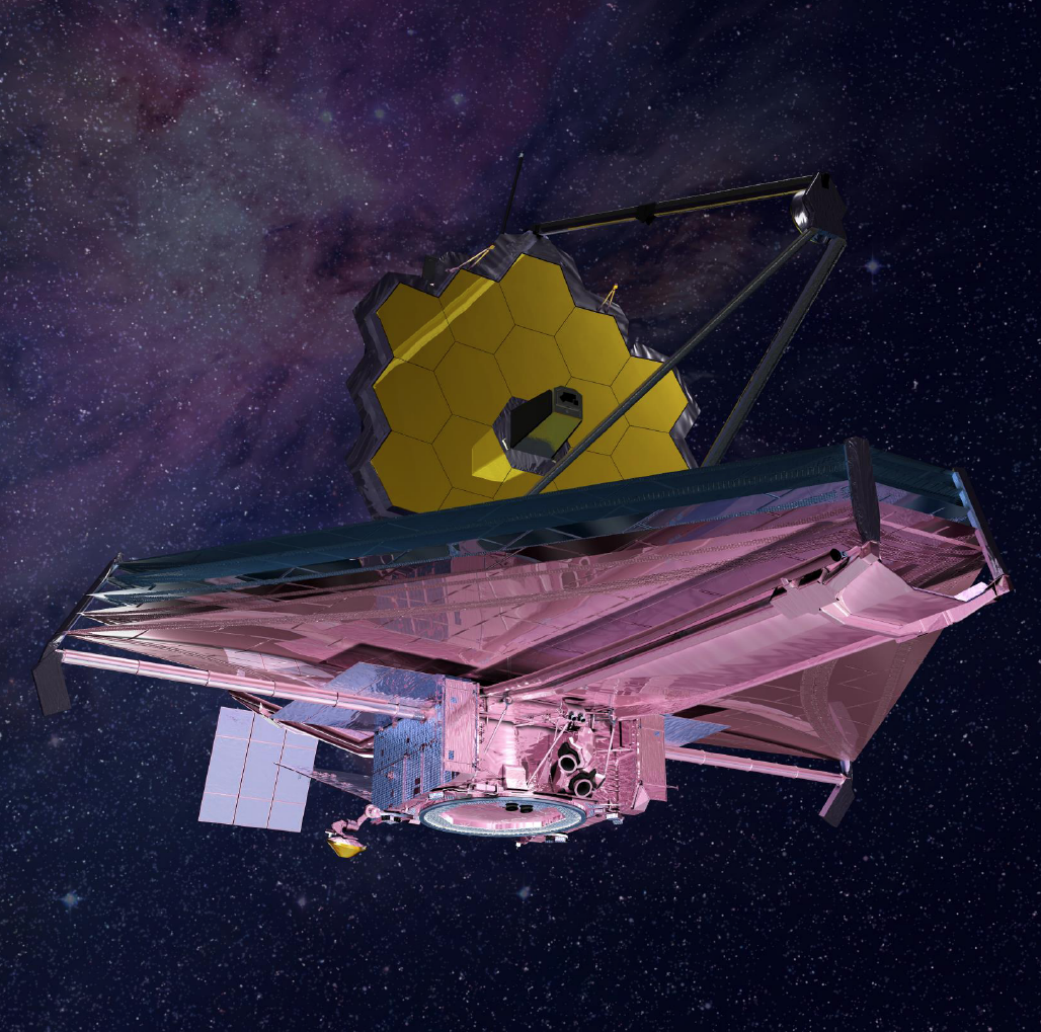
NASA’s James Webb Space Telescope has made a significant discovery by identifying the host galaxy of the farthest known fast radio burst, designated FRB 20240304B. This burst, which was first detected on March 4, 2024, is believed to originate from a small dwarf galaxy that is actively forming stars.
Discovery Details
Fast radio bursts are brief, intense flashes of radio waves from the distant universe, with their origins still largely unknown. The MeerTRAP team first detected FRB 20240304B using the MeerKAT telescope. However, locating its host galaxy proved challenging, as the largest ground-based telescopes could not identify any galaxy at the specified coordinates. The researchers then utilized Webb’s advanced capabilities to confirm the galaxy’s presence.
Webb’s Near-Infrared Camera (NIRCam) successfully identified a galaxy in the designated area, while the Near-Infrared Spectrograph (NIRSpec) measured the galaxy’s redshift at 2.148. This indicates that the galaxy existed approximately 3 billion years after the Big Bang, significantly earlier than most previously detected fast radio bursts.
Characteristics of the Host Galaxy
The discovered galaxy stands out as it is 1,000 times less massive than typical galaxies associated with fast radio bursts, which are usually larger and more evolved.
Co-author Ben Stappers from the University of Manchester emphasized the unexpected nature of this finding, highlighting the unique characteristics of the host galaxy compared to others in their sample. The galaxy, which existed during a peak period of star formation known as “cosmic noon,” is actively creating stars, with most likely having formed within the last 30 million years.
Implications for Fast Radio Burst Research
This discovery has important implications for understanding the origins of fast radio bursts. While one theory suggests that such bursts could result from the merger of neutron stars, which would typically occur in older galaxies, the characteristics of FRB 20240304B’s host galaxy lean toward a different origin. Another theory posits that fast radio bursts may arise from young, highly magnetic neutron stars known as magnetars, which could produce these bursts shortly after a supernova event.
Caleb’s findings suggest that the merger theory is less likely for this particular fast radio burst. The research also illustrates Webb’s capability to advance astrophysical knowledge, with co-author Themiya Nanayakkara noting its role in pushing boundaries beyond previous possibilities.
Future of Fast Radio Burst Exploration
The team is optimistic about the potential for discovering more distant fast radio bursts, estimating that the MeerKAT telescope could identify several more FRBs with redshifts greater than 1.0 each year. As additional radio telescope facilities and instruments become operational, the pace of discovery is expected to increase, with Webb playing a crucial role in characterizing the host galaxies of these distant bursts.
The James Webb Space Telescope, an international collaboration led by NASA in partnership with the European Space Agency and the Canadian Space Agency, continues to unravel mysteries about the universe, investigating solar system phenomena and exploring the formation of distant galaxies.
Source: NASA