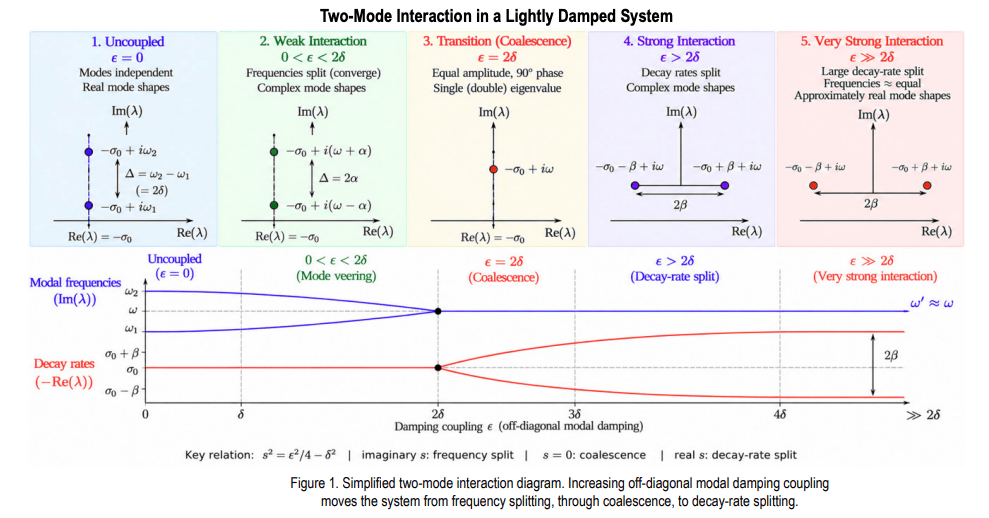
Recent research highlights how complex mode shapes can arise in linear structures with low overall damping, particularly when two structural modes are closely spaced in frequency and exhibit nonproportional damping. This phenomenon can lead to significant changes in frequency and modal behavior as the interaction between the modes increases.
Understanding Mode Interaction
As the coupling interaction heightens, the frequencies of the two modes move closer together, and their mode shapes become more intricate. Upon reaching a critical level of interaction, the frequencies converge, remaining nearly equal while their decay rates diverge. In situations of strong interaction, the mode shapes revert to being approximately real, albeit as different combinations of the original uncoupled modes. This research provides insights into mode veering, complex mode formation, eigenvalue coalescence, and decay-rate splitting in lightly damped systems.
Classical Modal Analysis Limitations
Traditional modal analysis often assumes that lightly damped structures behave as nearly proportional systems with real mode shapes. However, this assumption can be misleading when two modes are closely spaced. The introduction of nonproportional damping creates an off-diagonal coupling term that necessitates a reevaluation of the damping’s significance relative to the frequency separation.
Framework for Eigenvalue Analysis
The study establishes a reduced perturbation framework for closely spaced modal pairs. It defines a central eigenvalue and expresses the coupled eigenvalues based on specific assumptions. The relationship derived from these assumptions determines the separation direction of eigenvalues in the complex plane, indicating how decay rates and frequencies interact under varying levels of damping.
Engineering Implications
Complex mode shapes should not necessarily be construed as indicators of heavy damping or nonlinearity. The analysis encourages engineers to examine complex poles alongside mode shape phase to discern frequency convergence and decay-rate separation. This approach aids in estimating effective interaction strength and proximity to the transition boundary, offering a practical connection between test analysis and theoretical frameworks.
This research has been documented in a NASA technical memorandum, providing a comprehensive analysis of the emergence of complex modes in lightly damped structural systems.
Source: NASA