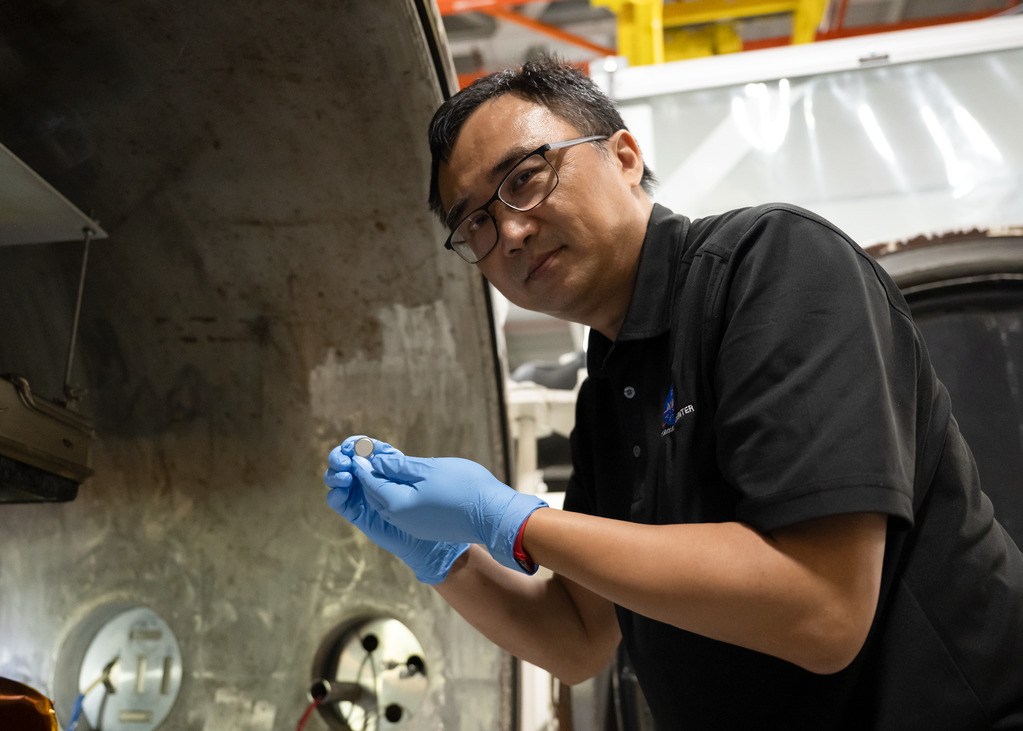
NASA is advancing its efforts to develop a new battery technology capable of operating in the extreme cold of the Moon’s South Pole, where temperatures can drop to minus 328 degrees Fahrenheit. The project, known as Solid Power for Extreme Environment Adaptability and Resilience in Space (SPEARS), aims to support future lunar missions as part of the Artemis campaign.
Battery Challenges in Space
Conventional batteries, like those found in everyday electronics, struggle in extreme temperatures due to their reliance on liquid electrolytes, which can freeze or evaporate. SPEARS batteries address these issues by utilizing solid ceramic or polymer-based materials instead of liquids, allowing them to function in both extreme cold and heat. Recent tests showed that prototype cells performed effectively at temperatures from 176 degrees Fahrenheit down to minus 76 degrees Fahrenheit, and could operate even at minus 112 degrees Fahrenheit with reduced performance.
Yi Lin, the SPEARS testing and research lead at NASA Langley, noted that their tests demonstrated the batteries’ capability to survive severe temperature fluctuations without sustaining damage. This resilience is crucial for equipment that will be used on the Moon, where night and day temperatures vary dramatically.
Innovative Solutions for Lunar Missions
The SPEARS project aims to develop batteries that not only operate reliably but also safely. The solid-state design means the batteries do not freeze at extremely low temperatures, which is a significant advantage over traditional batteries. Additionally, small heaters can be used to bring the batteries to operational temperature when needed, potentially simplifying the thermal management systems required for spacecraft and lunar habitats.
This technology has a wide range of potential applications, from powering astronaut tools and rovers to supplying energy for long-duration scientific instruments. The versatility of the SPEARS batteries allows for customization based on specific needs, whether that be energy, power, or durability.
Future Applications Beyond the Moon
While designed for space exploration, the SPEARS technology could also have implications for Earth-based applications. The project, which began in 2026, is funded by NASA’s Advanced Research and Technology division and may eventually lead to commercial collaborations. NASA’s Ames Research Center is also involved, working on developing flight hardware to prepare the batteries for testing in space environments.
Ji Su, a polymer materials scientist and task lead at NASA Langley, emphasized the broad market potential for solid-state batteries, indicating their applicability in various fields including automotive and portable electronic devices. As research progresses, these innovations may ultimately benefit both lunar missions and everyday technology on Earth.
Source: NASA