Unofficial results show voters elected Graham and Ugenti Rita to Scottsdale City Council

Unofficial results show voters elected Graham and Ugenti-Rita to Scottsdale City Council

Barry Graham has won re-election, and Michelle Ugenti-Rita has secured a seat on the Scottsdale City Council following the Nov. 3 General Election, according to unofficial results from the Maricopa County Elections Department. The election saw nearly 72% of registered voters in Scottsdale participating. This election determined the final two of three City Council seats…

Read more
Supervisor Galvin criticizes fellow Republicans and praises a flawless midterm election

Supervisor Galvin criticizes fellow Republicans and praises a flawless midterm election

Supervisor Thomas Galvin criticized fellow Republicans for prioritizing conspiracy theories over core conservative values, following the results of the recent 2026 Midterm Election. Galvin expressed his concerns about the direction of the party during a statement highlighting the electoral outcomes in Maricopa County and nationwide. Galvin, who has been on the Maricopa County Board of…

Read more
Scientists uncover the cause of Japan's massive 131 foot tsunami

Scientists uncover the cause of Japan’s massive 131-foot tsunami

Fifteen years following the devastating earthquake in Japan in 2011, associate professor Christine Regalla, along with a team of international researchers, conducted extensive studies of the seafloor to investigate the factors that contributed to the tsunami’s enormous size. Regalla’s research aims to shed light on the geological and environmental conditions that led to the catastrophic…

Read more
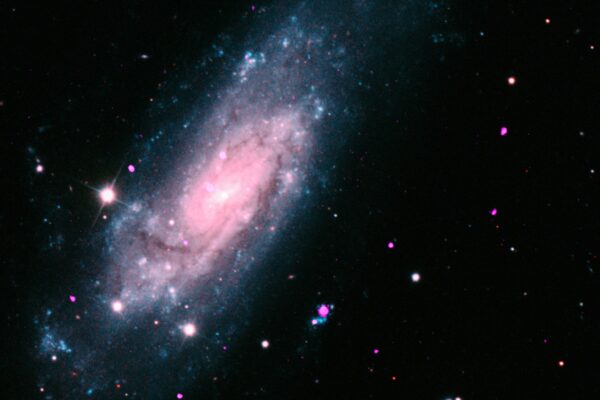
This release features a composite image of a spiral galaxy with a giant, unstable star at its outer edge. Using Chandra, astronomers have discovered the star’s previously hidden companion, which triggers luminous outbursts every 113 days. The spiral galaxy is NGC 4559. Shown at a sharp angle in the composite image, its flat pink and milky blue face tilts toward our upper left. Sitting near the outer edge of the dense spiral, near the center of the frame, is a small group of pink and blue dots. This group is outlined with a white square, enlarged and annotated in supporting images. The smallest pink dot in the square is AT 2016blu, a massive star some 33 times the size of our Sun. For over 15 years astronomers have been watching this star get bright and then dim again in optical light on a regular basis. Chandra’s X-ray observations suggest that a hidden companion object, either a stellar mass black hole or a neutron star, is pulling material from AT 2016blu every 113 days as they orbit one another. This captured material gets so hot that it shines brightly in X-rays. Other pink and blue specks within the white square and enlargement are unresolved stars or star clusters, too distant to be related to the movement of material between AT 2016blu and its hidden but influential neighbor.

Massive star produces outbursts

Astronomers using NASA’s Chandra X-ray Observatory have identified the cause of repeated outbursts from a massive star in the spiral galaxy NGC 4559, located approximately 30 million light-years from Earth. The findings were announced on November 9, 2026. The star, designated AT 2016blu, is characterized as unstable and has an estimated mass of at least…

Read more
WAATS showcases modern aviation training and LSCO readiness during CNGB visit

WAATS showcases modern aviation training and LSCO readiness during CNGB visit

Gen. Steven S. Nordhaus, the chief of the National Guard Bureau, visited the Western Army National Guard Aviation Training Site in Marana, Arizona, on October 28. During his visit, he interacted with Soldiers and observed both aviation maintenance and simulation training. This visit coincided with the site’s recent celebration of its 40th anniversary. The Western…

Read more
A global rebound occurs for mangroves

A global rebound occurs for mangroves

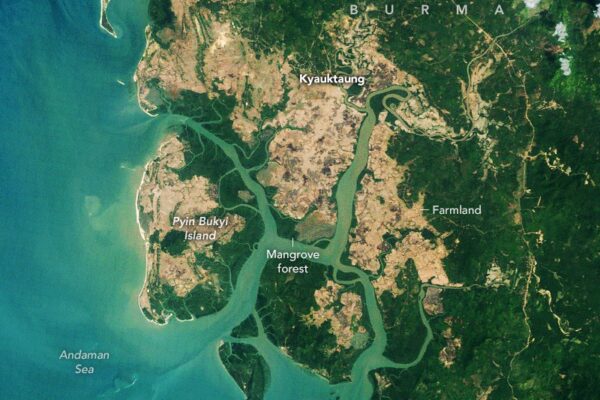
Scientists have reported a significant global rebound in mangrove forests, reversing decades of loss and degradation. Research published in the journal Science highlights the expansion of mangrove ecosystems, particularly in Asia, Australia, and South America, following a recovery that began around 2010. The study analyzed Landsat imagery from 1984 to 2023, revealing a loss of…

Read more