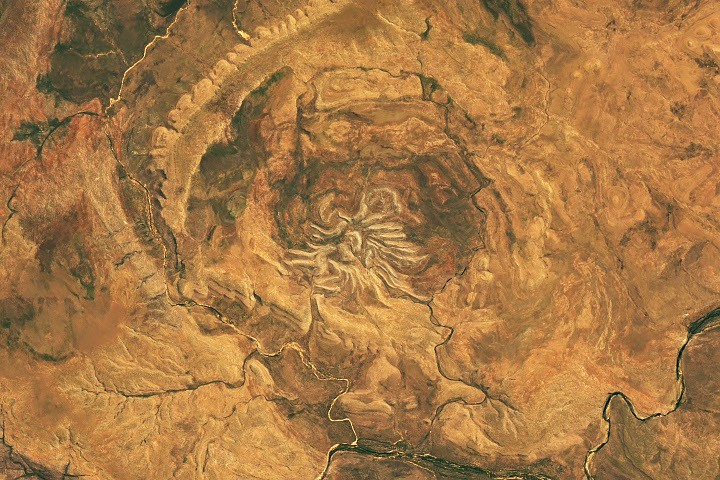
A distinctive geological feature known as Spider Crater, located in Western Australia’s Kimberley region, has been captured in a recent image by NASA’s Landsat 9 satellite. The crater, resulting from a meteorite impact and subsequent erosion over millions of years, measures approximately 13 kilometers by 11 kilometers (8 miles by 7 miles).
Geological Significance
Spider Crater showcases a unique arachnoid pattern, with a central portion about 4 kilometers (2.5 miles) wide. Geologists believe this design is a remnant of the crater’s central uplift formed by the rebound of shock waves during the impact. The lighter sandstone ridges, resembling spider legs, have withstood erosion while surrounding rock layers have diminished over time.
Research Findings
Initially, scientists debated the origins of the crater, with some suggesting a volcanic background. However, field studies revealed evidence of its impact history, including fan-shaped fractures known as shatter cones, which indicate intense shock waves passing through the rock. These features are prevalent in the crater’s central dome.
Further laboratory analyses of shocked quartz and zircon crystals from the area are underway, which could provide insights into the meteorite’s angle of impact. While the exact date of the impact remains uncertain, estimates suggest it occurred between 900 million and 600 million years ago, indicating that Spider Crater dates back to the late Precambrian era.
This information was reported by NASA Earth Observatory, highlighting the geological and historical significance of Spider Crater as a remarkable structure shaped by cosmic events.
Source: NASA