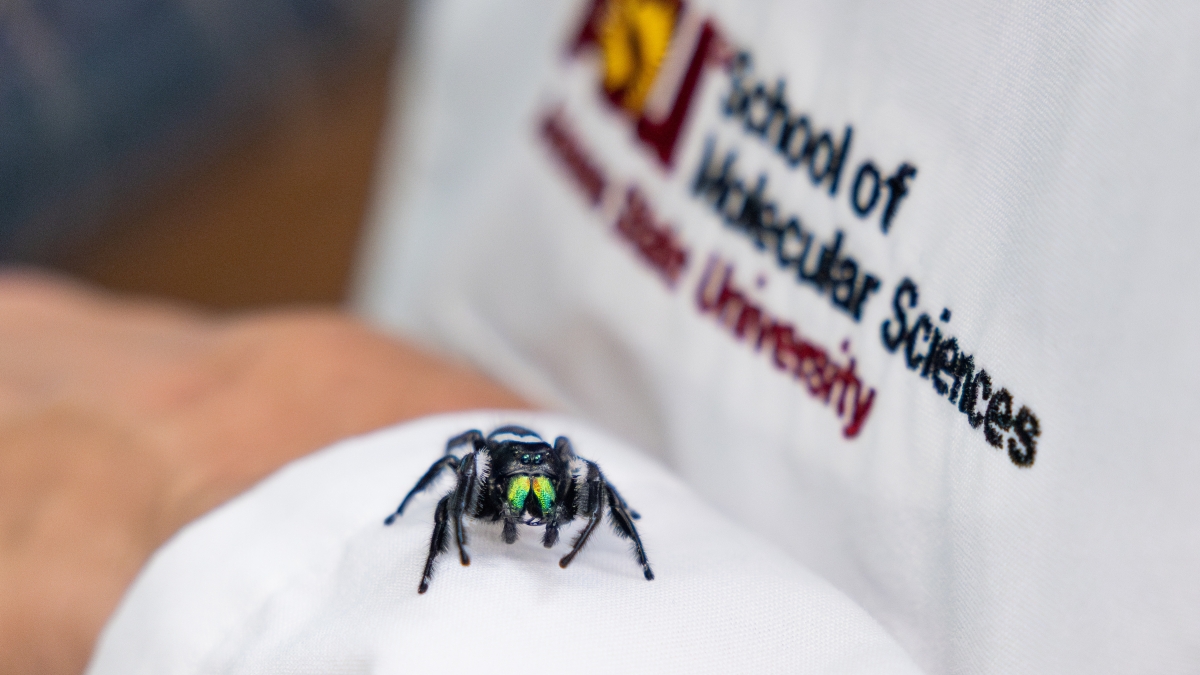
Recent research highlights the regal jumping spider as a potential inspiration for future Spider-Man adaptations, emphasizing its unique biological traits that align more closely with the superhero’s abilities than the traditionally depicted black widow. This tiny arachnid, known for its impressive jumping skills and sophisticated silk production, offers an opportunity to explore scientific narratives in popular media.
Characteristics of the Regal Jumping Spider
The regal jumping spider, scientifically known as Phidippus regius, measures about 2 cm in length and is native to the southeastern United States and the Caribbean. Mary Ellen Lewis, a recent medicinal chemistry graduate from Arizona State University, describes this spider as harmless to humans, with large, forward-facing eyes that enhance its vision. Unlike the passive web-building black widow, jumping spiders actively hunt their prey, utilizing their agility to leap distances several times their body length.
The Evolution of Spider Silk
While many are familiar with the silk of orb-weaving spiders, Lewis’s research focuses on the silk of jumping spiders, which possesses distinct properties suitable for advanced biomedical applications. Professor Jeff Yarger notes that the increasing interest in jumping spider silk stems not only from its physical attributes but also from its various uses, such as constructing shelters and egg cases. This adaptability raises questions about how evolution has shaped the silk’s characteristics to fit a non-web-building lifestyle.
Insights into Silk Structure
In her research, Lewis analyzed silk from different parts of the jumping spider’s habitat, discovering a complex architecture that varies significantly depending on its function. For example, the silk used in egg cases was found to be thicker than that of many web-building spiders. This variation suggests that jumping spiders have evolved specialized silk suited to their unique ecological niche.
Molecular Memory of Spider Silk
One of the most intriguing findings from Lewis’s study involves the silk’s molecular structure and its reaction to moisture. Using advanced techniques, researchers identified that the beta-sheet content in the silk increases when exposed to water, leading to a permanent change in its molecular arrangement. This phenomenon, described as molecular memory, indicates that the silk can retain characteristics influenced by environmental conditions, even after it dries.
Future Applications and Research Directions
The implications of understanding jumping spider silk could extend to designing innovative protein-based materials with adjustable properties after production. Researchers are currently conducting further experiments to delve deeper into the silk’s structure and its responses to environmental factors. These studies may pave the way for developing materials that combine strength, flexibility, and responsiveness to changing conditions, inspired by the remarkable adaptations of the regal jumping spider.
Source: Arizona State University