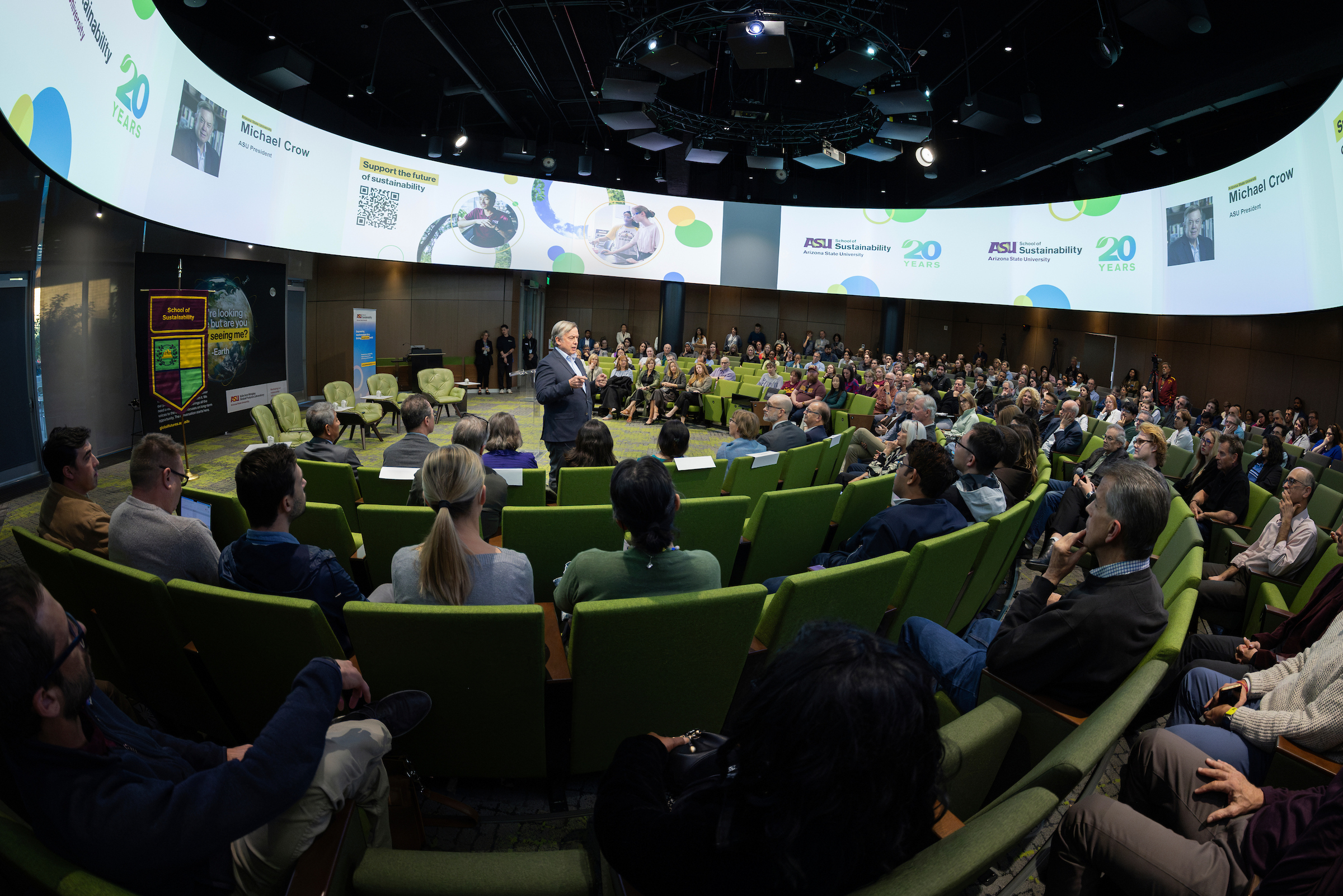
Arizona State University celebrated the 20th anniversary of its School of Sustainability on Nov. 23 at the Walton Center for Planetary Health. The milestone event brought together founders, faculty, and alumni to reflect on the school’s growth and ongoing commitment to addressing sustainability challenges.
Foundational Vision and Growth
Julie Ann Wrigley, a key figure in the school’s establishment, expressed surprise at reaching this anniversary, stating that she had not anticipated its significance. Wrigley recalled discussions with ASU President Michael M. Crow about creating a school focused on sustainability, which began as an ambitious yet somewhat undefined concept. Today, the School of Sustainability is recognized as a pioneering academic program in the United States.
During the anniversary celebration, Joshua Abbott, the school’s director, noted its evolution from a small faculty to a robust program with over 50 faculty members, 17 academic programs, and more than 650 students. He highlighted the accomplishments of the school’s 3,500 alumni, who are now working globally across various sectors. Abbott remarked, “Our little school is all grown up and officially a young adult.”
Transdisciplinary Approach
The School of Sustainability opened in fall 2006, aiming to create a transdisciplinary curriculum that addressed complex societal and environmental issues. Abbott pointed out that the school has had to invent many of its own systems, as there were no established career paths or frameworks for sustainability education at that time.
Peter Schlosser, vice president and director of the Global Futures Laboratory, emphasized the school’s role in connecting research with real-world applications. He stated that the original model aimed to tackle issues that could not be solved within traditional academic boundaries. Schlosser called for the field of sustainability to adapt to the shifting challenges posed by ecological disruptions and social divisions.
Looking Ahead
The celebration included a panel discussion titled “Looking Back, Looking Forward: A Conversation on the Future of Sustainability.” Moderated by Sonja Klinsky, the panel featured faculty members discussing the importance of education, partnerships, and practical experiences for students. Associate Professor Rimjhim Aggarwal reflected on the early challenges of building the program, asserting that the responsibility of creating something new requires constant adaptation to meet evolving needs.
Panelists highlighted initiatives such as immersive courses and paid internships to prepare students for future leadership roles in sustainability. Kathleen Merrigan, executive director of the Swette Center for Sustainable Food Systems, noted the significance of experiential learning in fostering innovation.
Future Directions
Wrigley expressed her astonishment at the school’s growth, saying it has surpassed her initial expectations. Crow affirmed the progress made over the past two decades while encouraging attendees to remain focused on future opportunities. “Are we on the road to better things? Yes,” he concluded, reinforcing the enduring commitment to sustainability that defines the School of Sustainability at ASU.
Source: Arizona State University