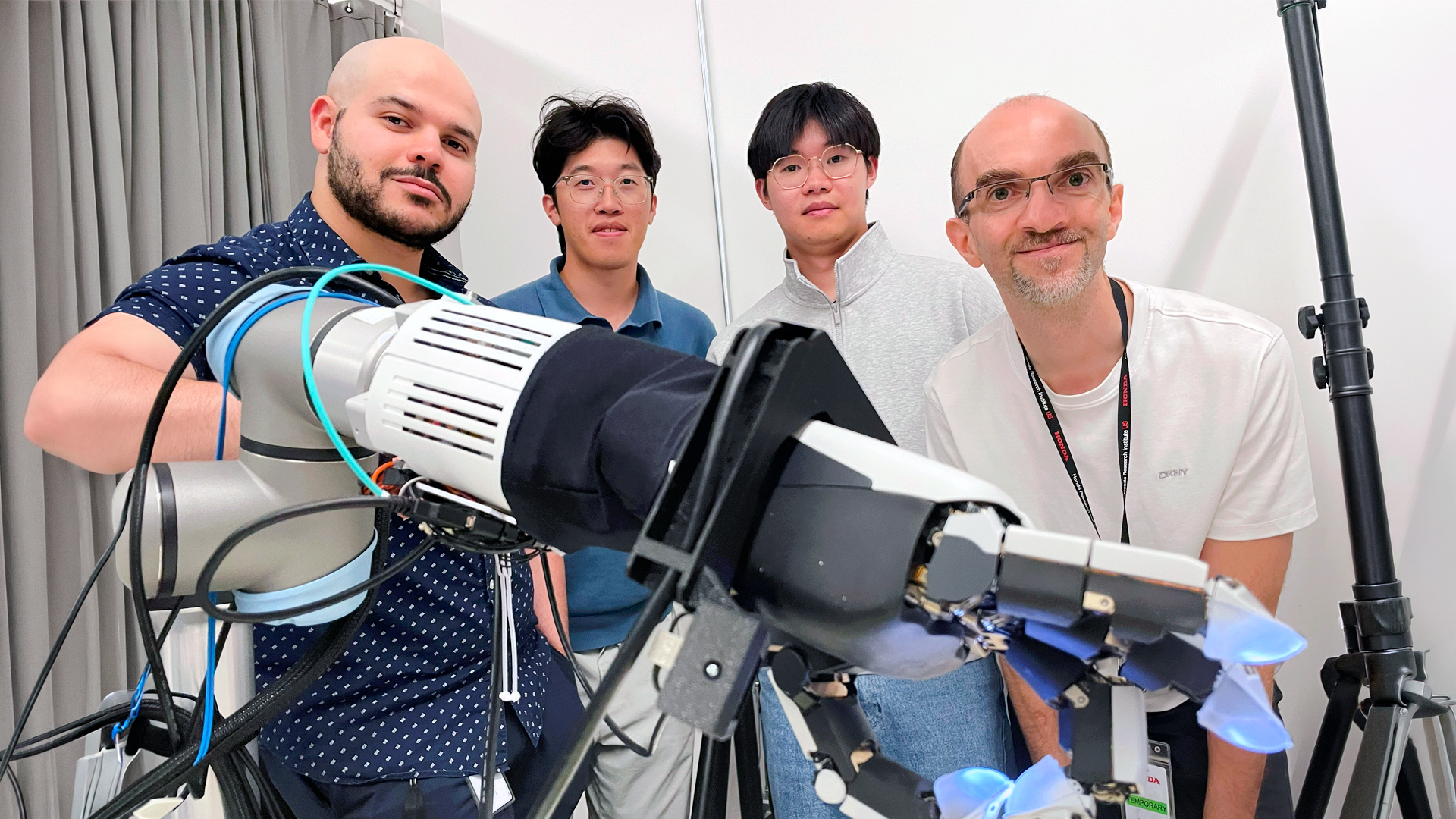
Arizona State University students had the unique opportunity to collaborate with Honda Research Institute USA in San Jose, California, where they explored advanced robotics technology. Over a three-week period, students and faculty worked with Honda’s dexterous multi-fingered robotic hand, aimed at enhancing automation and robotics capabilities.
Collaboration with Honda
Heni Ben Amor, a professor in ASU’s School of Computing and Augmented Intelligence, led the project, which was part of Honda’s initiative to support academic research in robotics. ASU was one of four universities selected for this program, alongside the University of Michigan, Northwestern University, and the University of Southern California. The initiative provides faculty-led teams access to sophisticated hardware and resources to investigate the future possibilities of artificial intelligence in robotics.
Hands-On Experience
Students involved in the project included Mohamed El Mistiri, Xuechao Zhang, and Hsiang (Sean) Fu. Fu expressed that the collaborative environment allowed for the exchange of ideas among participants from various backgrounds. The project allowed students to engage directly with advanced robotic technology, which is not often available in academic settings.
Understanding Robotic Dexterity
The Honda robotic hand features 16 joints, giving it the ability to perform complex movements similar to those of a human hand. This level of dexterity is crucial for tasks in manufacturing that require adaptability, such as handling irregularly shaped objects. Soshi Iba, division director at Honda Research Institute USA, noted that developing robots capable of intricate manual tasks remains a significant challenge in the field.
Research Focus
Ben Amor’s team concentrated on enhancing in-context learning and adaptation for dexterous manipulation. This research aims to enable robots to apply learned skills to new tasks and environments without the need for extensive programming. Ben Amor described the objective as evolving from traditional conversational AI to action-oriented AI, which could allow robots to communicate their actions and reasoning in everyday language.
Impact on Robotics Education
The collaboration between ASU and Honda is seen as a pivotal experience for students, transitioning them from theoretical learning to practical application in a real-world context. Ross Maciejewski, director of the School of Computing and Augmented Intelligence, highlighted the importance of hands-on experience in shaping the next generation of roboticists.
Overall, the partnership illustrates how industry and academia can work together to advance robotics technology and education, preparing students for future challenges in this rapidly evolving field.
Source: Arizona State University