An innovative manufacturing method developed by researchers at Arizona State University could revolutionize the creation of complex composite structures for aircraft. This new approach eliminates the need for dedicated molds, tooling, and temporary support materials, significantly reducing production time and costs.
Advancing Composite Manufacturing
Mostafa Yourdkhani, an associate professor of manufacturing engineering, is spearheading this project. He aims to integrate material and process design with robotic fabrication to enable the rapid production of lightweight structures. According to Yourdkhani, the removal of traditional tooling barriers could facilitate the production of specialized parts in smaller quantities, allowing for quicker design adaptations and the creation of complex shapes that were previously challenging to achieve.
Yourdkhani’s team has begun working on internal components for aircraft and wind turbine structures, focusing on panels that support aircraft wings. Their advanced manufacturing techniques could streamline the production of these components, making the process more economical and less time-consuming than before.
High-Tech Research Facilities
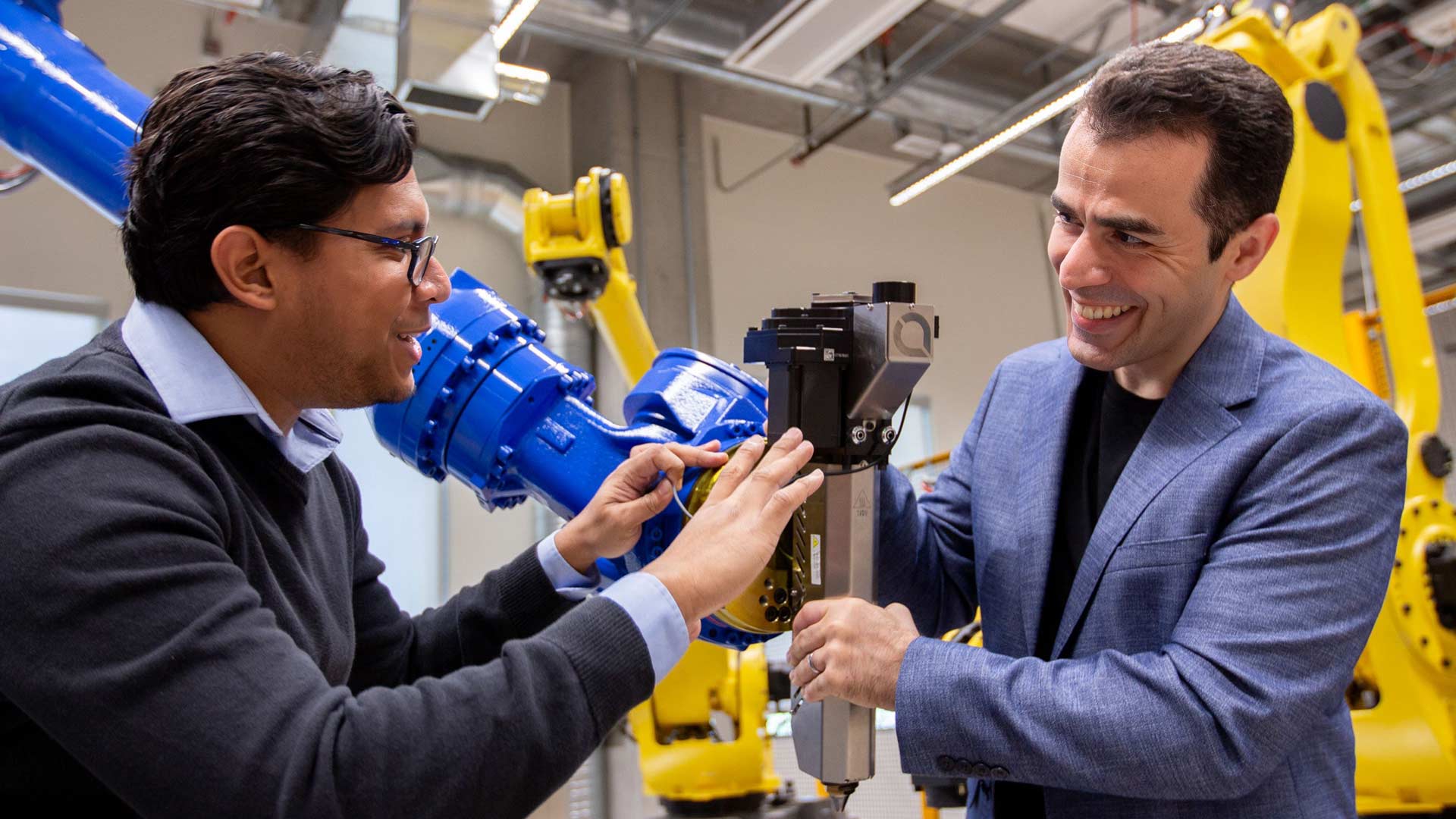
Research for this project is conducted in two specialized areas within the Interdisciplinary Science and Technology Building 12 at ASU’s Polytechnic campus. The Composites and Polymer Science and Engineering Lab (ComPoSE Lab) is dedicated to developing materials and analyzing their processing conditions. The recently established NEXUS robotic cell allows for experimentation with a broader range of materials and full-scale parts typically not feasible within the lab.
The robotic cell features large robotic arms designed for manufacturing substantial structures while enabling the study of material performance at an industrial level. This facility supports collaborative efforts using multiple materials and manufacturing scales,, while in-situ monitoring enhances process efficiency.
Automation in Composite Production
Yourdkhani’s research stems from a pivotal question regarding the failure of composite materials. His earlier studies indicated that manufacturing processes significantly influence the internal structure and performance of composites. Traditional manufacturing involves numerous manual steps, which can lead to inconsistencies. By automating these processes, the goal is to create a more reproducible, digitally controlled manufacturing environment.
The NEXUS robotic cell, featuring three industrial robotic arms, is designed for collaborative work. Two of these arms were donated by Dexcom, a company specializing in medical devices. Yourdkhani envisioned the lab as an integrated system where multiple robots operate across various production stages, from manufacturing to inspection.
Training the Next Generation
Students involved in this research, like doctoral student Rajdeep Adak, gain hands-on experience with industrial-scale technology, addressing automation challenges faced in the aerospace and automotive industries. Adak noted that the experience equips students with essential skills in robot kinematics and industrial control systems.
Yourdkhani emphasized the potential of this research, stating that they have successfully reduced the timeline for manufacturing high-performance polymers and composites from weeks or months to mere minutes or hours. This groundbreaking work not only highlights the capabilities of advanced manufacturing systems but also brings promising concepts closer to actual production applications.
Source: Arizona State University