NASA astrophysicists have published two studies detailing how the upcoming Laser Interferometer Space Antenna (LISA) observatory could identify new exoplanets in our galaxy by detecting gravitational waves, which are ripples in space-time generated by orbiting masses. This research could open up new avenues for understanding exoplanets beyond our solar system.
Detecting Exoplanets Through Gravitational Waves
The studies indicate that LISA could detect Jupiter-mass planets in binary systems of white dwarfs from thousands of light-years away. Casey McGrath, a postdoctoral researcher at the University of Maryland and NASA’s Goddard Space Flight Center, explained that the presence of an exoplanet alters the gravitational wave signals emitted by these tightly orbiting white dwarfs. This alteration allows scientists to uncover the planet’s existence through the gravitational wave data.
The first paper, authored solely by McGrath, focuses on the detection method and the optimal planet masses and orbital periods for successful identification. The second paper, co-authored by McGrath and others, discusses how NASA’s James Webb Space Telescope could confirm these planets.
Development of the LISA Mission
The concept of detecting exoplanets around double white dwarf systems was first proposed in 2008 by Japanese astronomer Naoki Seto. The LISA mission, led by the European Space Agency, is expected to launch in the mid-2030s, with NASA providing critical hardware and scientific support.
LISA’s detection method is akin to the radial velocity method, which tracks stellar wobbles caused by orbiting planets. However, LISA will instead analyze gravitational waves. Scott Noble, a theoretical astrophysicist at NASA Goddard and a co-author of the confirmation paper, noted that the gravitational waves emitted by double white dwarfs will exhibit variations due to the gravitational influence of a planet, creating additional signals that can be detected.
Confirming Exoplanets with the James Webb Telescope
The studies suggest that LISA could identify approximately 10,000 double white dwarf systems, along with about 100 mixed binary systems containing neutron stars or black holes. Mary Anne Limbach, an assistant research scientist at the University of Michigan, emphasized the importance of validating LISA’s initial exoplanet detections to ensure they are genuine and not false positives.
To confirm the presence of these exoplanets, the research team has proposed leveraging the infrared sensitivity of the James Webb Space Telescope, which can detect additional infrared light from planets in double white dwarf systems, significantly beyond what the stars emit. This method could allow Webb to identify an exoplanet five times the mass of Jupiter.
Technical Aspects of the LISA Observatory
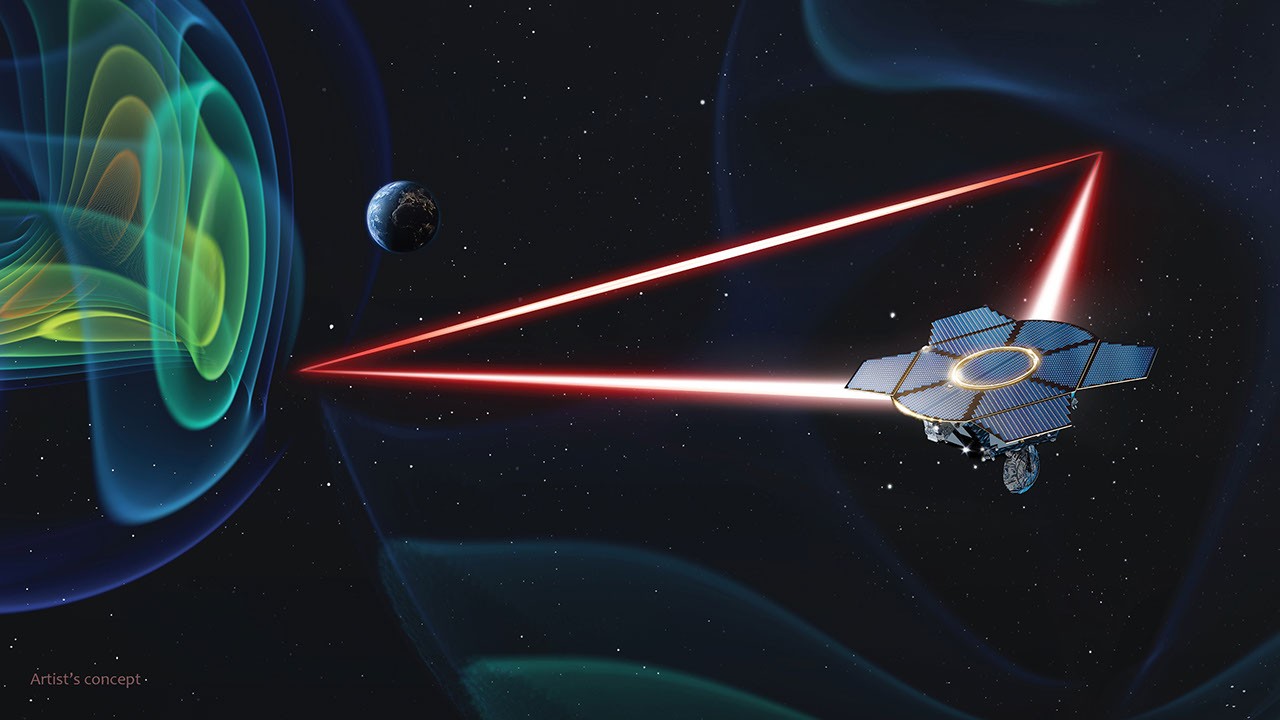
The LISA observatory will consist of three spacecraft forming a triangular array, each separated by 1.6 million miles. These spacecraft will utilize infrared laser beams to measure minute changes in their distances, which correspond to passing gravitational waves. Gravitational waves were first detected in 2015, confirming a prediction made by Albert Einstein over a century ago, and have since provided valuable insights into the universe.
NASA’s contributions to the LISA mission also include the development of a laser system and enhancements for data analysis, which are crucial for identifying and characterizing gravitational wave sources.
Source: NASA