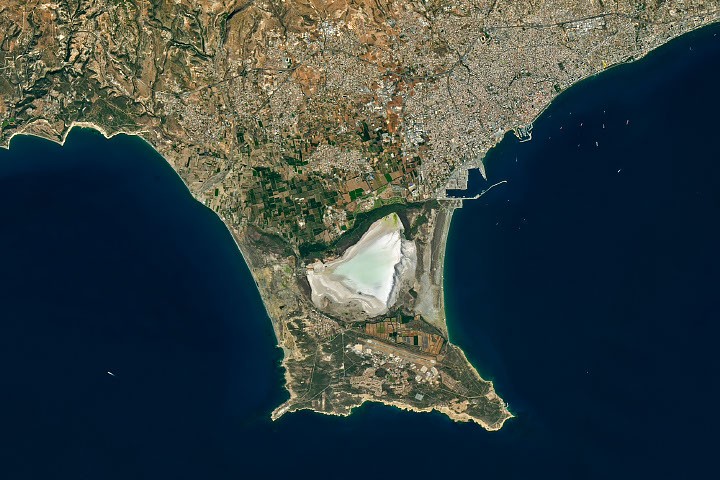
Recent imagery from NASA’s Operational Land Imager on Landsat 8 captured the Akrotiri Peninsula in Cyprus, revealing the seasonal changes in Akrotiri Salt Lake as rains filled the area. The image was taken on October 10, 2026, showcasing the lake’s fluctuating water levels as it transitions from autumn and winter to summer.
Geological History
The island of Cyprus began forming approximately 90 million years ago during the Late Cretaceous period through volcanic activity that created new oceanic crust. Tectonic forces later pushed parts of this crust upwards, resulting in the rugged terrain of the island, particularly visible in the Troodos Mountains. Over geological time, various sedimentary rock layers accumulated around the island, contributing to the formation of a smaller island to the south, which eventually merged with the main landmass to create the Akrotiri Peninsula.
The peninsula’s sandy edges are evident in the recent images, illustrating the geographical features shaped by both river sediment and marine deposits. The Kouris River tombolo, which developed around 50,000 years ago, and a second tombolo that emerged in the last 2,000 years, together separate the salt lake from the Mediterranean Sea.
Flamingo Population Decline
Akrotiri Salt Lake experiences significant seasonal water level changes, typically filling during late autumn and winter while drying out in the summer months. This seasonal influx has historically attracted large populations of flamingos, which feed on fairy shrimp that provide the birds with their distinctive coloration. However, reports indicate a dramatic decline in the flamingo population, which dropped from an average of 4,000 to just 30 birds in 2025.
Snakes and Cats of Cyprus
The island is also known for its snake population, historically referred to as Ophiousa, meaning “land of snakes.” The ancient Romans responded to concerns about the snake population by introducing cats from Egypt to control them, particularly in an area that became known as Cape Gata, or Cape Cat. Today, the Holy Monastery of St. Nicholas of the Cats at Cape Gata continues to care for hundreds of cats, with the feline population on the island reportedly matching the number of human residents, exceeding one million.
The recent imagery and historical context highlight the unique ecological and geological characteristics of Cyprus, illustrating how natural and human influences have shaped the island over millennia.
Source: NASA