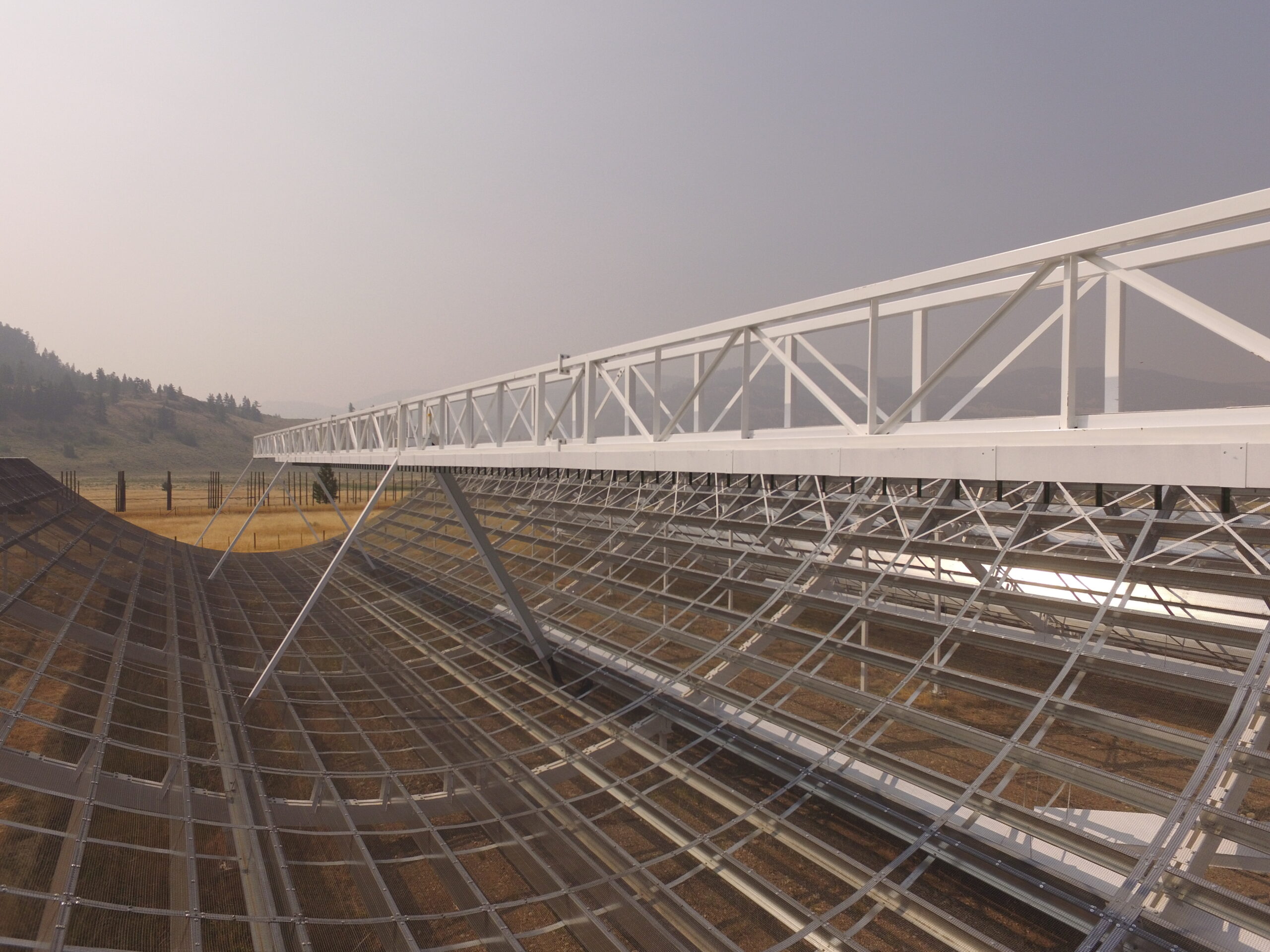
Researchers at Arizona State University have contributed to a significant advancement in understanding the universe’s history through the Canadian Hydrogen Intensity Mapping Experiment (CHIME) telescope, which detected hydrogen glow from a time when the universe was approximately 5 billion years old. The findings were recently published in The Astrophysical Journal.
CHIME’s Innovative Approach
CHIME, located in British Columbia, Canada, employs a technique called “21cm intensity mapping” to analyze the distribution of hydrogen gas across a vast area of the observable universe. This method enables scientists to investigate the cosmic arrangement of matter by measuring radiation emitted from neutral hydrogen clouds. The data collected can provide insights into dark energy, a mysterious force believed to be accelerating the universe’s expansion.
Despite initial skepticism regarding the effectiveness of this technique, the CHIME team, including ASU postdoctoral researchers Shabbir Shaikh and Albin Joseph, alongside Assistant Professor Simon Foreman, successfully demonstrated its potential. They achieved this by measuring hydrogen clustering without relying on data from additional telescopes, marking a significant milestone in astrophysical research.
Implications of the Findings
Foreman noted the significance of this measurement. The researchers’ ability to independently analyze the hydrogen distribution is crucial due to existing debates within the scientific community regarding dark energy and other universal properties.
Both Shaikh and Joseph were instrumental in linking CHIME’s measurements to the understanding of neutral hydrogen distribution in galaxies. Their analysis revealed that the characteristics of the hydrogen signal could reflect the conditions of the universe around 8 billion years ago, likening it to a fingerprint of cosmic evolution.
Future Research Directions
The collaboration involving ASU and several Canadian institutions aims to refine the understanding of hydrogen’s role in the universe. Shaikh mentioned that discrepancies between observed clustering measurements and advanced galaxy formation simulations highlight the necessity for ongoing research into hydrogen distribution.
Foreman elaborated on CHIME’s objectives, emphasizing the importance of mapping hydrogen gas distribution to glean insights into the universe’s growth and the enigma of dark energy. The hope is that by gathering data from various time periods, researchers can better understand the history of cosmic expansion.
As CHIME continues to refine its techniques, the researchers anticipate achieving higher precision in their measurements, which could lead to groundbreaking revelations about the universe. The findings from this study not only underscore the potential of CHIME but also open new avenues for exploration in astrophysics.
Source: Arizona State University