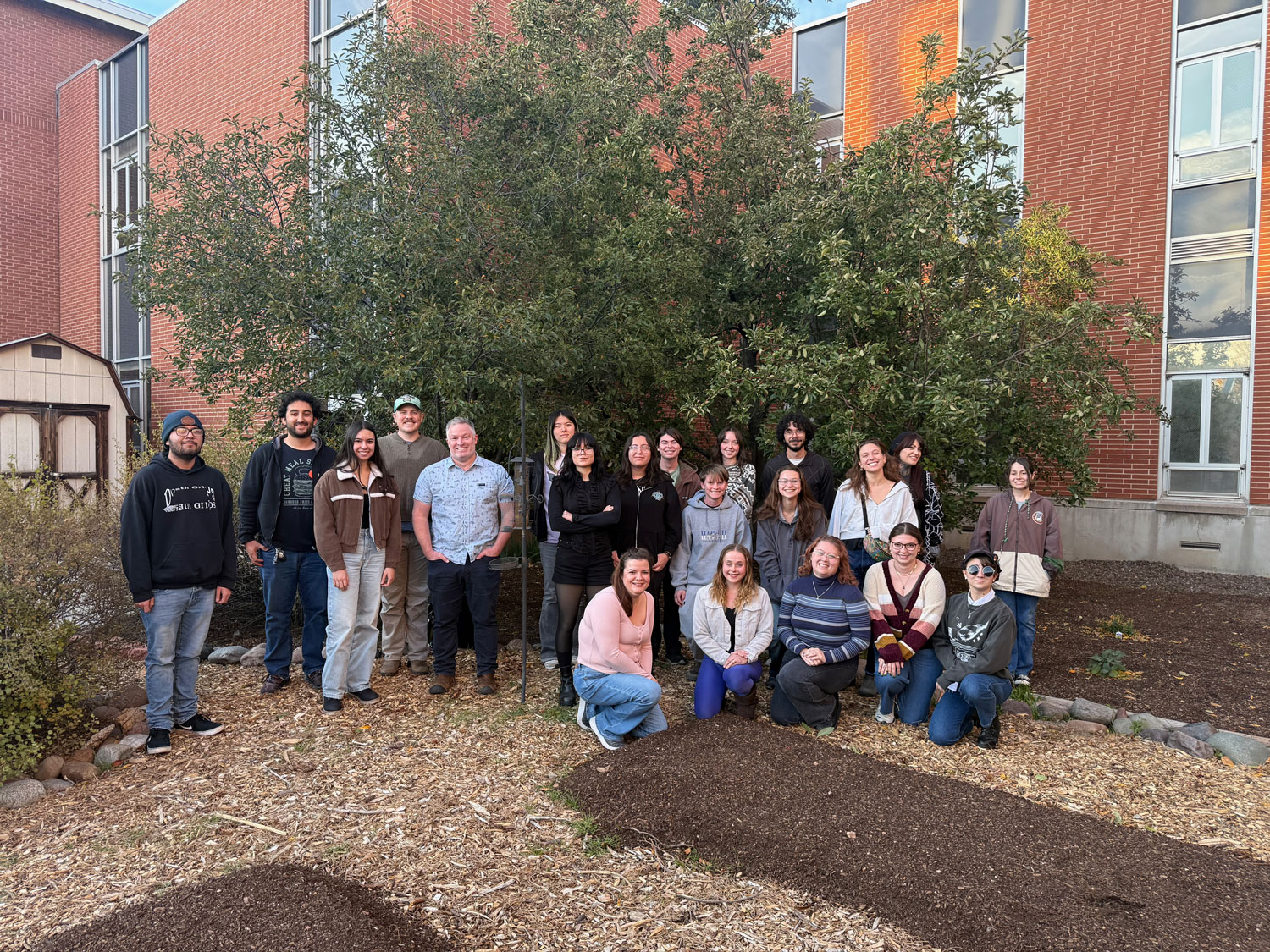
NAU Students Engage in Genome Sequencing Project
Students in a biology course at Northern Arizona University (NAU) are taking on an ambitious project that typically requires years of work by professional scientists: sequencing and assembling the entire genome of a plant. Under the guidance of assistant professor Richard Hodel, the course focuses on the shrub Prunus fasciculata, commonly known as desert almond, which is found throughout Arizona and other western states.
By the end of the semester, the students will not only have sequenced the entire genome of the desert almond but will also prepare a manuscript for publication, gaining firsthand experience in the research process. This initiative is part of the American Campus Tree Genomes program, which aims to introduce students to bioinformatics and genomics through practical research rather than theoretical exercises.
Researching Adaptations to Harsh Environments
Graduate student Riley Jackson, who assists in teaching the course, highlighted the relevance of the desert almond, noting that it is a wild relative of stone fruits like apricots and plums. The research aims to uncover the genetic traits that enable plants to thrive in arid conditions, particularly as climate change leads to increased heat and drought in the Southwest.
The project holds significance as it explores the genetic basis of drought tolerance and adaptation to saline soils, knowledge that could potentially be applied to enhance agricultural crops. The desert almond’s unique reproductive strategy, involving separate male and female plants, adds another layer of complexity to the research, as plant sex systems in desert environments are not well understood.
Discovering New Genetic Information
The students and researchers have already made a noteworthy discovery: the desert almond appears to have four copies of all its chromosomes, a condition known as polyploidy. This finding is intriguing, as it has not been documented in the desert almond’s closest relatives, and the class is now investigating how these extra chromosome sets may assist the species in adapting to extreme desert conditions.
Jackson emphasized the unique nature of the class, where students engage in genuine scientific research rather than predetermined experiments. The current work involves collecting plant samples, extracting DNA, sequencing genetic materials, and assembling vast amounts of data into a comprehensive genome—a complex task that relies on collaborative effort.
Practical Skills and Career Opportunities
The project equips students with valuable practical skills applicable to careers in biological sciences, agriculture, and biotechnology. It also introduces them to bioinformatics, a burgeoning field that merges biology with data science for genetic studies.
Student Liz Mott, a double major in biology and Spanish, expressed her enthusiasm for the course, noting that it has broadened her understanding of botanical work and the life cycle of plants. Mott remarked on the extensive skills and insights she gained, which now allow her to comprehend the journey from field collection to genome visualization.
Source: Northern Arizona University