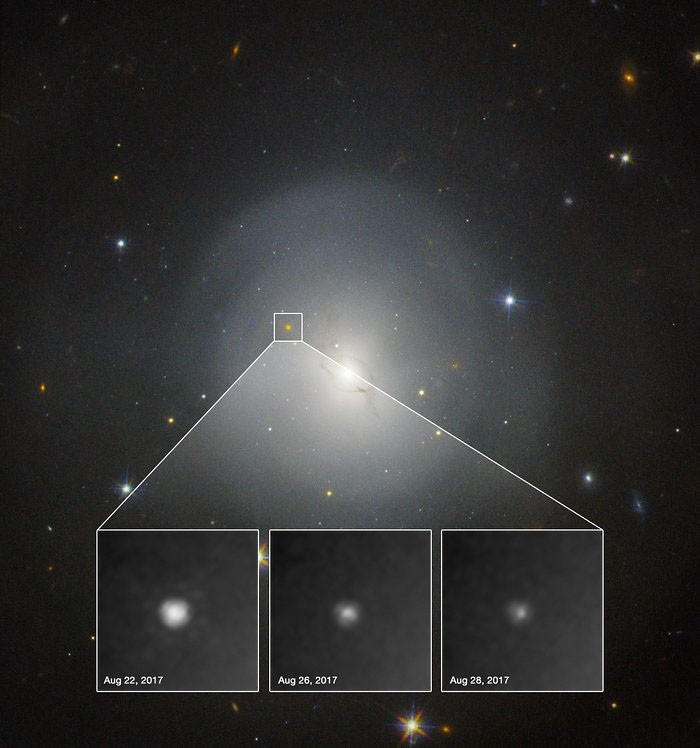
Using NASA’s Chandra X-ray Observatory, researchers have identified a hidden companion object that triggers regular outbursts from a giant star known as AT 2016blu. This discovery, detailed in a study published in The Astrophysical Journal, reveals that the companion, either a stellar-mass black hole or a neutron star, pulls material from the massive star every 113 days as they orbit each other.
Located in the spiral galaxy NGC 4559, approximately 30 million light-years from Earth, AT 2016blu is classified as a luminous blue variable star, estimated to be at least 33 times the mass of the Sun. The star has been observed to brighten and dim regularly for over 15 years, exhibiting behavior similar to a supernova but without being destroyed in the process. This behavior has earned it the nickname “supernova impostor.”
Mojgan Aghakhanloo, a researcher from the University of Virginia, noted that the regular fluctuations in brightness were puzzling until the team obtained timely Chandra data. “Until we were able to get Chandra data at the right time, we couldn’t figure out what was making this happen,” Aghakhanloo said.
Astronomers have detected at least 27 optical bursts from AT 2016blu between 2012 and 2026, occurring roughly every 113 days. The study’s co-author, Núria Torres-Albà, also from the University of Virginia, emphasized the importance of X-ray data to understand the cause of these eruptions, stating that the star’s behavior resembled that of a supernova.
The Chandra observations, particularly in March 2026, indicated that AT 2016blu was over 100 times brighter in X-rays compared to earlier data from 2001 and 2002. This brightness is attributed to material from the star being captured by the black hole or neutron star during their closest approach in their elliptical orbit.
The findings suggest a possible link between ultra-luminous X-ray sources and explosive stellar outbursts such as those seen in AT 2016blu. These ultra-luminous sources are not fully understood and may include neutron stars and black holes.
To monitor the star’s brightness and gather the necessary optical data, the research team utilized several telescopes and collaborations, including the Katzman Automatic Imaging Telescope and the Las Cumbres Observatory Global Supernova Project. The Chandra observations were part of its “Target of Opportunity” program, which allows for immediate observations of noteworthy events.
NASA’s Marshall Space Flight Center manages the Chandra program, with the Smithsonian Astrophysical Observatory overseeing its scientific operations.
Source: NASA