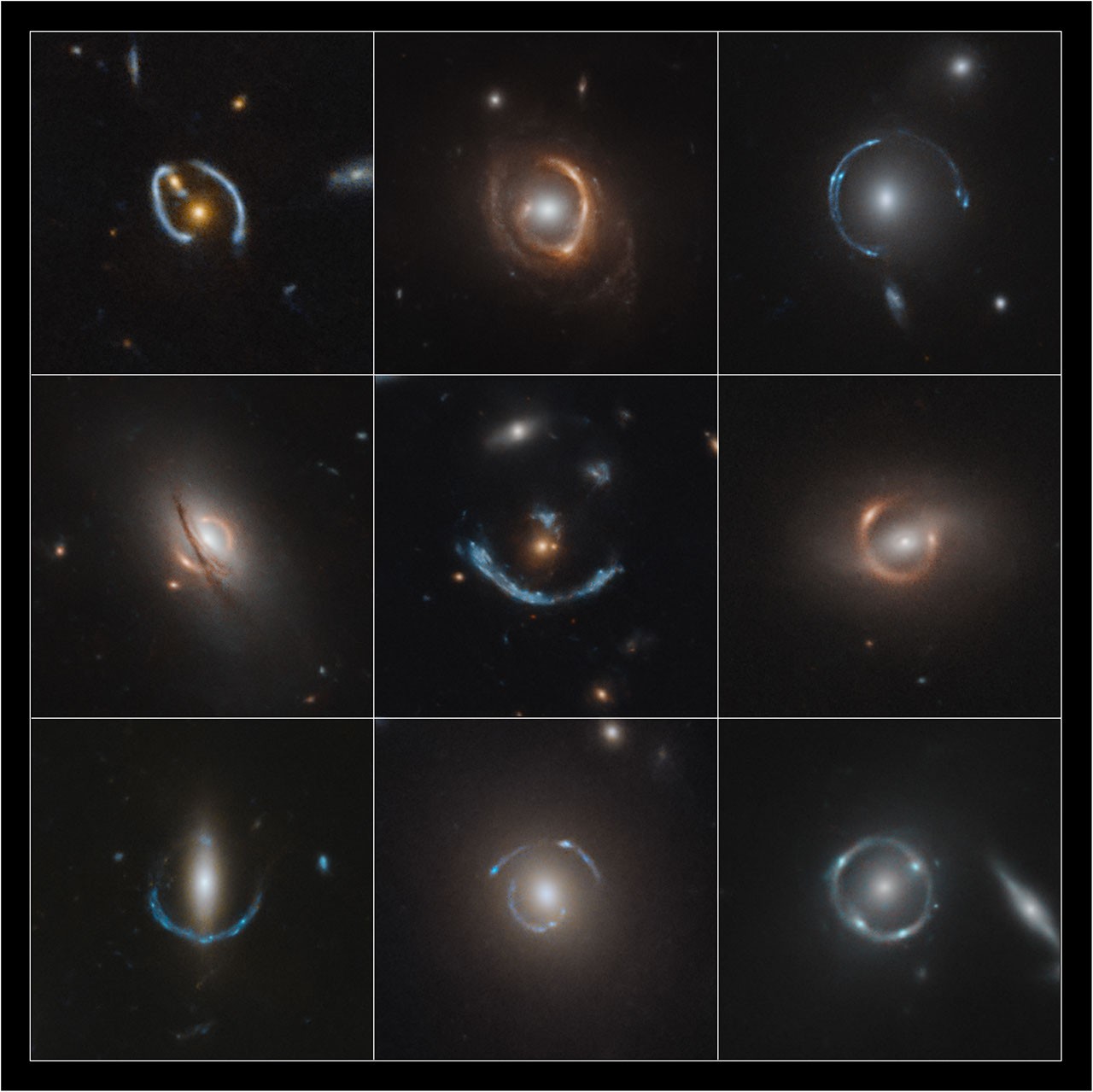
NASA’s Hubble Space Telescope has unveiled a collection of gravitational lenses that will serve as a foundation for future observations by the newly launched Nancy Grace Roman Space Telescope. This showcase of cosmic phenomena highlights the diverse characteristics of gravitational lensing, a phenomenon first predicted by Albert Einstein.
Gravitational lensing occurs when the gravity of a massive object, such as a galaxy, distorts light from a more distant background object. This effect acts like a giant lens, enabling astronomers to observe objects that are otherwise too far away for traditional telescopes. The recent images depict how the precise alignment of a distant galaxy with a foreground galaxy creates distorted and magnified views of the background galaxy, resulting in arcs around the foreground galaxy.
Implications for Dark Matter Research
Astronomers plan to use the observations of these gravitational lenses to construct models that will help estimate the mass of the lensing galaxies. This research could provide insight into dark matter, as the amount and distribution of mass in the foreground galaxies—including the elusive dark matter—can be inferred from the degree of distortion observed in the background galaxies.
Hubble specializes in capturing high-resolution images in visible and ultraviolet light, while Roman will primarily focus on infrared observations over a broader field of view. This collaboration is expected to enhance the understanding of gravitational lenses by allowing Roman to identify a greater number of lenses, while Hubble can provide detailed follow-up observations on individual cases.
Unique Characteristics of Gravitational Lenses
The recent collection of images features various types of gravitational lenses. For instance, some are shown as duplicated arcs, while others illustrate phenomena such as Einstein Rings, where the background galaxy appears to encircle the foreground galaxy. These diverse characteristics will assist researchers in studying the evolutionary paths of galaxies and the presence of dark matter.
Different colors in the lensed images indicate the ages of the stars within the galaxies, with blue arcs suggesting younger stars and red arcs indicating older stellar populations. Most of the foreground lensing galaxies are elliptical, but some exhibit spiral arms or unique features, such as visible dust lanes, providing further data for researchers.
Collaborative Efforts Among Space Observatories
The gravitational lenses were first detected using The Dark Energy Spectroscopic Instrument at Kitt Peak, followed by observations from Hubble. As Roman joins NASA’s family of large space observatories, which includes Hubble, the Chandra X-ray Observatory, and the James Webb Space Telescope, the combined efforts are expected to deepen humanity’s understanding of the cosmos.
This collaboration exemplifies how major space observatories work together to create a comprehensive picture of the universe, revealing previously hidden phenomena and expanding our cosmic knowledge.
Source: NASA