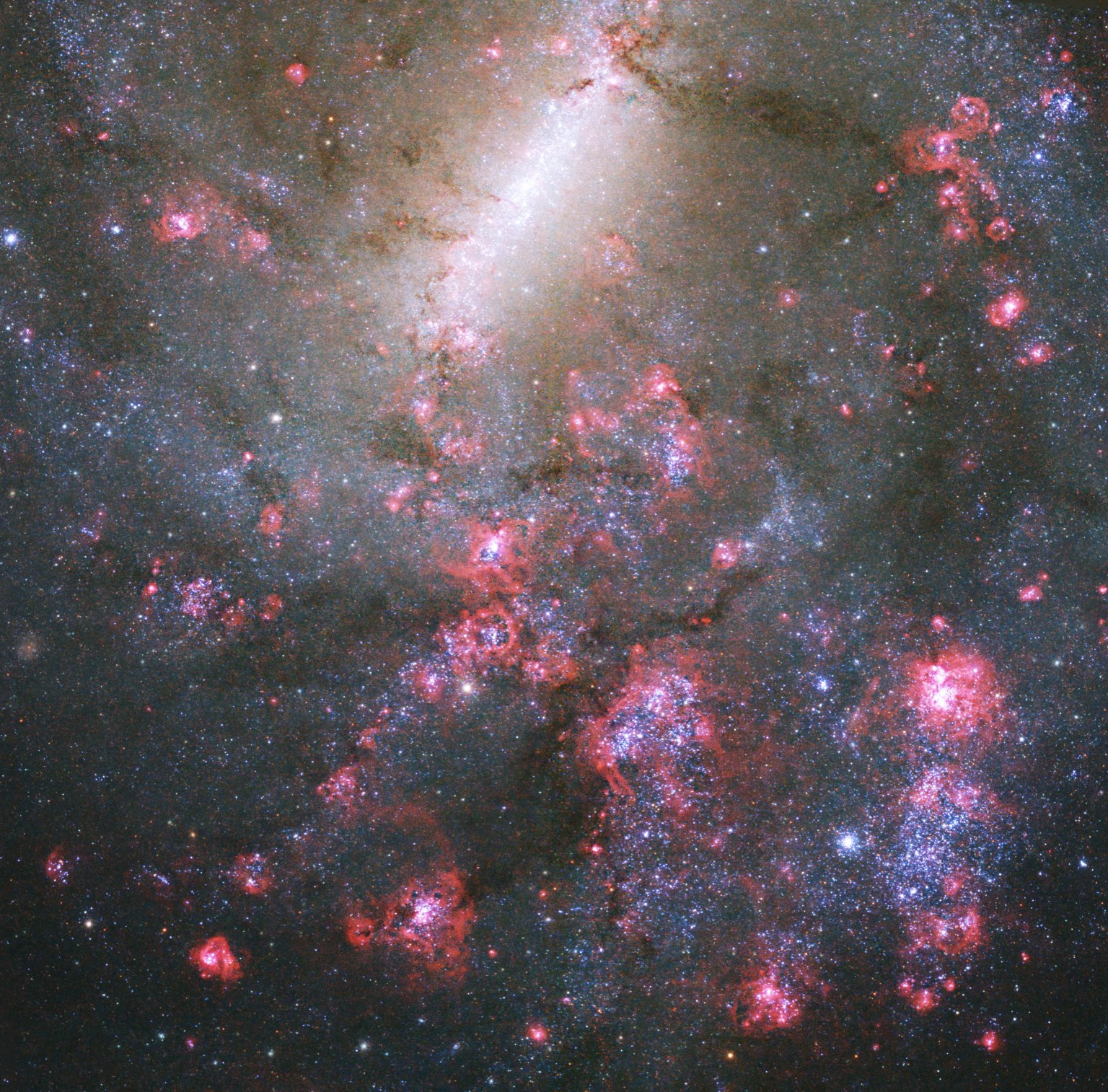
NASA’s Hubble Space Telescope recently captured a stunning image of NGC 1827, an edge-on, intermediate spiral galaxy located approximately 37 million light-years away in the constellation Columba. This observation is part of a broader survey aimed at studying 260 satellite galaxies surrounding 22 Milky Way-like host galaxies within a 32 million light-year radius from Earth.
Observation Details
The image, taken using Hubble’s Advanced Camera for Surveys, showcases the galaxy’s rusty-brown dust lanes that cut through its disk, highlighting areas where new stars are likely forming. Bright-blue regions within the galaxy contrast with the dark dust, while a bright foreground star appears near the galaxy’s central bulge, its distinctive diffraction spikes resulting from light interacting with Hubble’s internal structure.
Scientific Significance
This observing program focuses on low-mass galaxies, which are essential for testing cosmological models at smaller scales. The data collected by Hubble will enhance the understanding of the properties of these low-mass galaxies within Milky Way-like systems, enabling researchers to refine existing cosmological theories. Hubble has already observed 111 of the targeted satellite galaxies, with an additional 149 orbits planned for complete observation.
Ongoing Research and Impact
The findings from Hubble’s observations contribute significantly to our comprehension of the universe and the behavior of galaxies. By continuing to gather data from these low-mass galaxies, scientists aim to bridge gaps in current cosmological models, which have faced challenges in aligning predictions with observations.
For more information, contact Claire Andreoli at NASA’s Goddard Space Flight Center.
Source: NASA