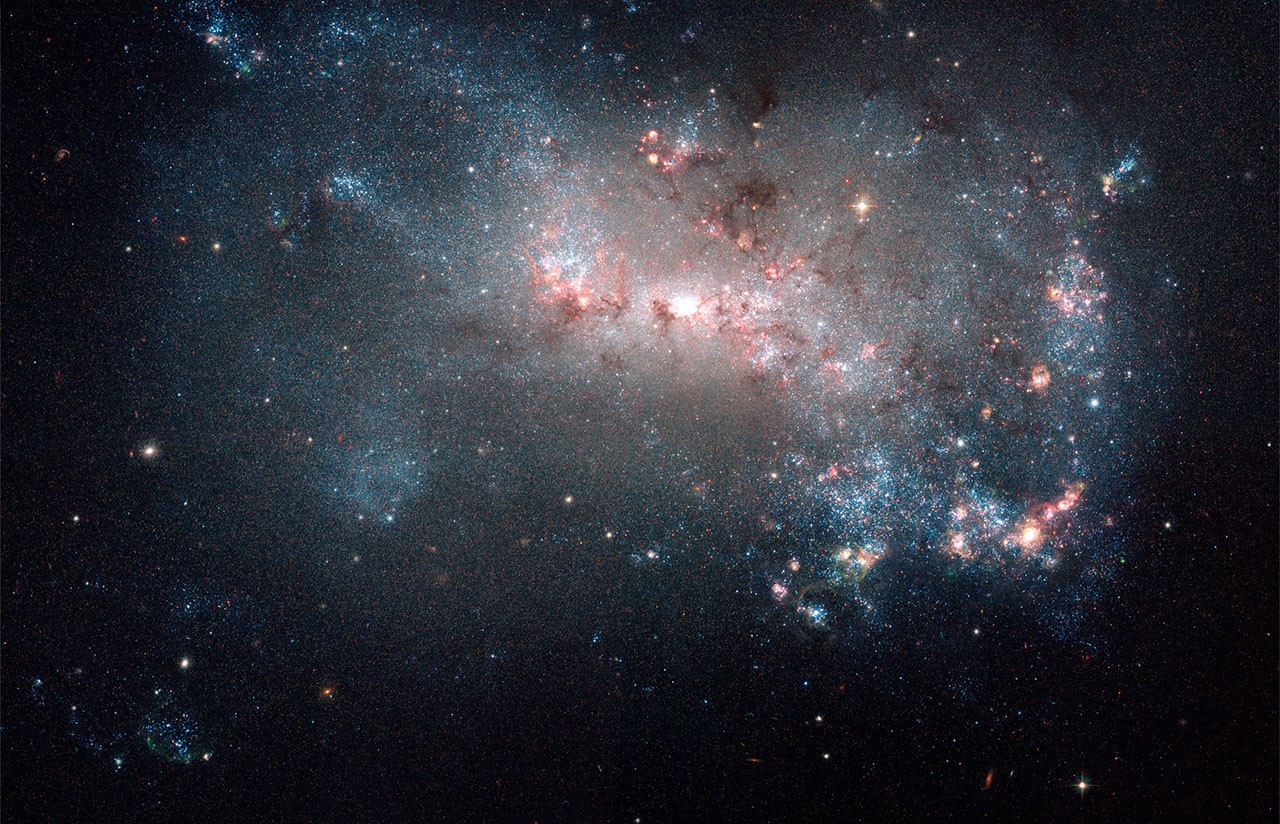
NASA’s Hubble Space Telescope has uncovered a significant mystery regarding the presence of oxygen in dwarf galaxies, as detailed in a study published in The Astrophysical Journal. Researchers examined 37 nearby dwarf galaxies and discovered that a substantial amount of expected oxygen is missing.
Findings on Oxygen Distribution
The study indicates that dwarf galaxies, which are smaller collections of stars, can retain only a small fraction of the oxygen generated by their stars. Simulations had predicted that these galaxies should contain more oxygen, leading researchers to question its whereabouts. Co-investigator Grace Telford, an assistant professor at the University of Utah, noted that oxygen must have been ejected from these galaxies, likely due to energy from massive stars and supernova explosions.
Understanding Oxygen’s Role
The Galaxies Losing Oxygen via Winds (GLOW) project, which is supported by NASA and the National Science Foundation, aims to trace the distribution of oxygen within stars, interstellar gas, and the space between galaxies. Oxygen, being the most abundant element after hydrogen and helium, serves as a practical indicator of chemical element distribution in galaxies, according to GLOW principal investigator Kristen Wingfield McQuinn.
Research Methodology
The researchers utilized archival optical data from Hubble to analyze star populations and their formation histories. Alongside data from the retired Spitzer Space Telescope and ground-based observatories, they focused on 37 dwarf galaxies close enough for Hubble to resolve their individual stars. The selection was based on the prediction that these galaxies would expel increasing amounts of oxygen through supernovae.
Future Research Directions
While previous studies have indicated that galaxies lose significant amounts of oxygen, the fate of this ejected material remains uncertain. The GLOW study aims to extend existing research on low-mass galaxies and identify where the expelled metals end up. McQuinn plans to use the Roman Space Telescope to locate even smaller galaxies and, with the help of Hubble and the James Webb Space Telescope, conduct deeper observations of their stars.
Telford is also looking to use Hubble for detailed studies of massive stars in these dwarf galaxies, aiming to better understand their characteristics and the oxygen they produce. The Hubble Space Telescope, operational for over three decades, continues to provide critical insights into the universe through its collaborative efforts between NASA and the European Space Agency.
Source: NASA