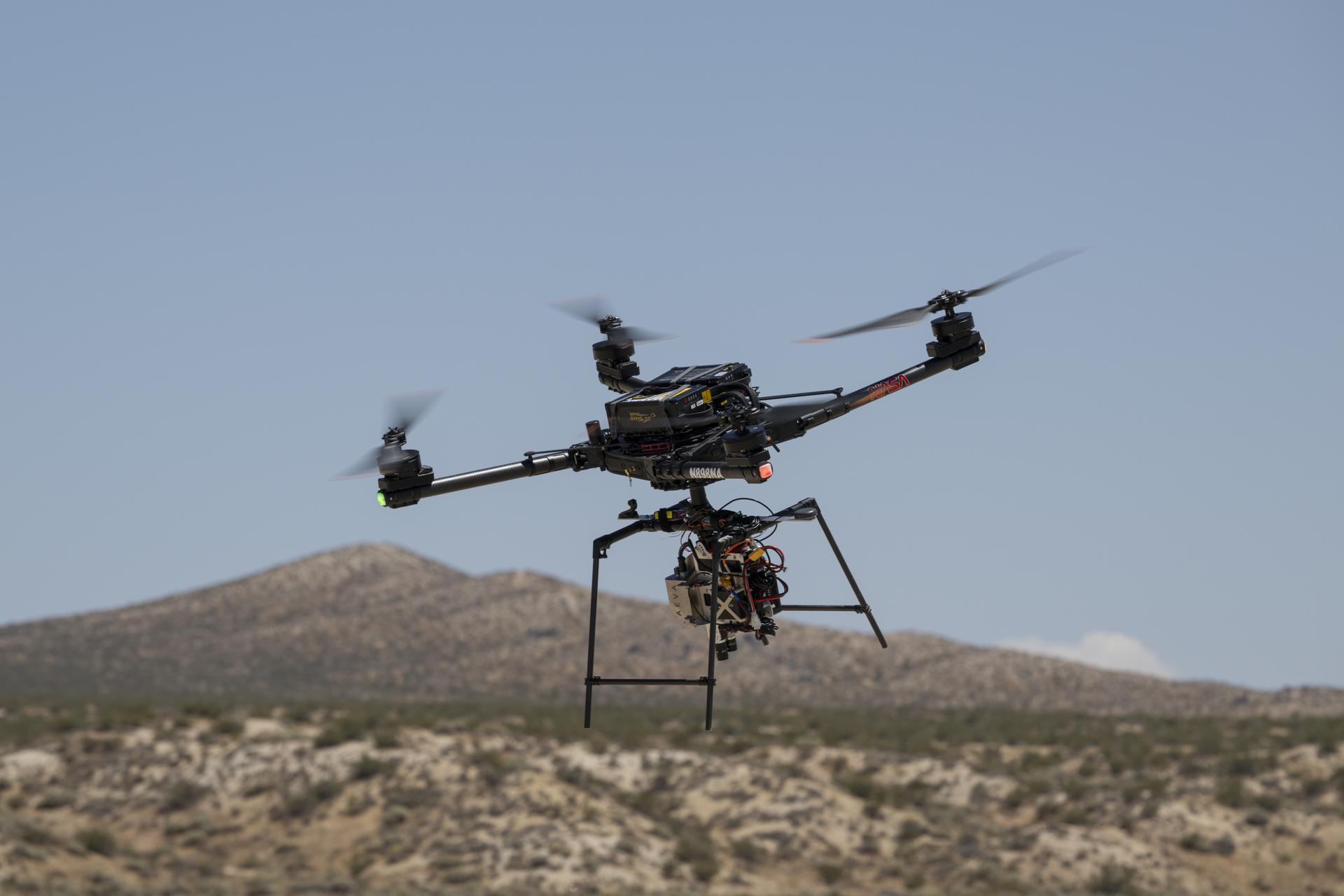
NASA has successfully demonstrated technology that allows spacecraft to autonomously navigate to safe landing sites on the Moon and other planets. An Alta-X drone equipped with the Safe and Precise Landing – Integrated Capabilities Evolution (SPLICE) payload executed simulated lunar descent and landing maneuvers on August 27 at Rogers Dry Lake, near the agency’s Armstrong Flight Research Center in Edwards, California.
Testing Advanced Navigation Systems
During the tests, the SPLICE payload utilized an advanced guidance system to create digital elevation maps and evaluate potential landing zones. If the system identifies an unsafe landing area, it can redirect the drone to a more secure location. This innovative technology is designed to enhance the safety and precision of landings for upcoming NASA missions to the Moon and Mars.
Davis Adams, the project manager for SPLICE, noted that the flight test represented the culmination of nearly a decade of development. He expressed that the successful demonstration raises the technology readiness level, making it suitable for future robotic and crewed lunar missions. The guidance and navigation systems validated during these tests are relevant for missions on Earth, the Moon, and Mars.
Collaboration and Future Applications
Researchers at NASA’s Johnson Space Center in Houston developed the SPLICE payload, collaborating with experts at NASA Armstrong to test and integrate the system on the Alta-X drone. These tests included verifying communication, data handling, telemetry, and command-control performance. A full-scale test is scheduled to take place at Voyager Technologies in Mojave, California, later this month.
NASA has been working with various commercial lunar lander providers to incorporate iterations of SPLICE into their systems. Several landers planned for future Moon Base missions will utilize data from SPLICE to achieve soft landings on the lunar surface.
Adams indicated that collaboration with industry is ongoing, as companies are assessing the navigation capabilities of the SPLICE system for precision landing applications and potential uses in autonomous surface mobility. The SPLICE guidance system is expected to be available in NASA’s software catalog this fall.
Foundation for Future Missions
The development of SPLICE has been supported by NASA’s Flight Opportunities project, which enabled early flight testing that has been crucial for advancing the system’s technology readiness. Previous tests included simulating descent altitudes and landing trajectories similar to those anticipated for lunar missions, alongside demonstrations of other precision landing sensor systems developed by NASA.
This comprehensive testing and validation process positions SPLICE as a key technology for ensuring safe landings on the Moon and beyond, as NASA continues to prepare for its upcoming missions.
Source: NASA