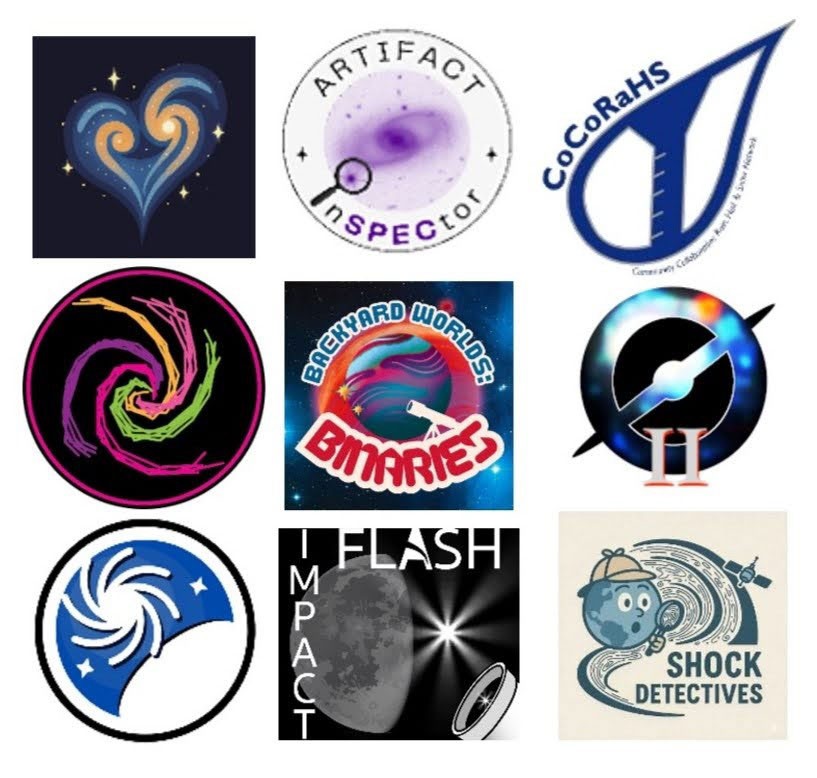
Nineteen new citizen science projects have been selected by NASA’s Science Mission Directorate, creating opportunities for volunteers to engage in scientific research. These initiatives, which include a variety of disciplines such as astrophysics and heliophysics, aim to involve the public in ongoing scientific investigations.
Citizen Science Seed Funding Program
NASA’s Citizen Science Seed Funding Program has approved twelve proposals aimed at expanding the use of citizen science in research. Among the projects is “The Rogue Worlds Project,” led by Jacqueline Faherty, which encourages volunteers to analyze data from the SPHEREx mission to identify free-floating planets and brown dwarfs. Another project, “Quantifying the calibrations between intrinsic galaxy merger timescales,” led by Kameswara Bharadwaj Mantha, invites participants to classify mock images of galaxies to improve understanding of galaxy mergers.
Other notable projects include “Overlap Zoo,” which focuses on characterizing overlapping galaxies, and “Planet Hunters Roman,” which seeks to identify exoplanets through gravitational lensing using data from NASA’s new Nancy Grace Roman Space Telescope.
Heliophysics and Planetary Sciences Initiatives
In the field of heliophysics, several projects are designed to engage citizen scientists in monitoring space weather. “Space Weather UnderGround,” led by Hyunju Connor, invites individuals to set up magnetometers to study disturbances in Earth’s magnetosphere. Additionally, “A Citizen Science Initiative for Sonified Plasma Wave Characterization” will allow volunteers to identify plasma waves by listening to sound signals generated from solar interactions.
For planetary sciences, the project “Mapping Lunar Iron Abundance Hotspots” aims to locate iron deposits on the Moon, while “Small Body Discovery and Outburst Monitoring” plans to establish a global network of citizen scientists to track cometary outbursts and small celestial bodies.
Science Activation Program Projects
The Science Activation Program also selected seven new projects to engage the public with NASA science. “Growing Beyond Earth,” led by Carl Lewis, trains students to conduct plant growth experiments relevant to future space missions. “Sungrazer 2.0” continues the legacy of its predecessor, encouraging volunteers to discover new comets using images from NASA missions.
Other projects include engaging amateur radio operators to study the ionosphere, expanding access to robotic telescopes for public use, and collaborative initiatives focused on monitoring lakes and studying Antarctic habitats. Each of these efforts aims to connect people with NASA’s scientific endeavors and foster a greater understanding of space and Earth sciences.
Source: NASA