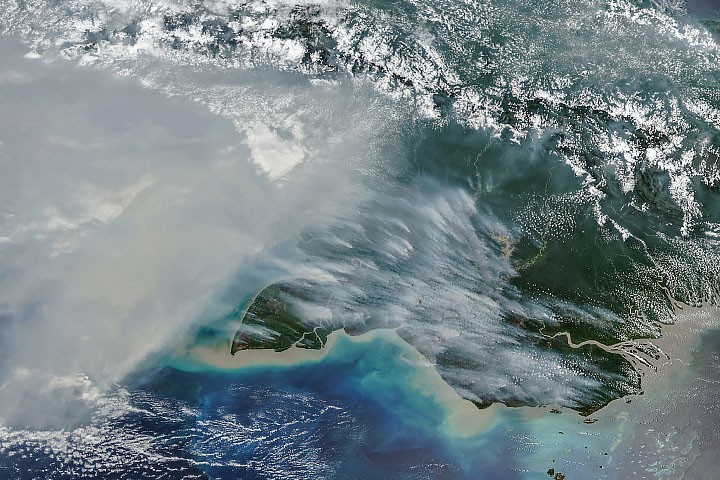
In recent weeks, New Guinea has experienced devastating fires fueled by drought conditions linked to a strong El Niño event. Smoke has enveloped large areas of the island, leading to significant air quality issues, flight cancellations, and school closures.
Impact of Drought and Fires
The Visible Infrared Imaging Radiometer Suite (VIIRS) on the NOAA-20 satellite captured images of thick smoke emanating from the southern region of New Guinea on October 11, 2026. Authorities have recommended that vulnerable populations, such as children and the elderly, wear masks due to the hazardous air quality. Robert Field, an associate research scientist at NASA, described the situation as “a horrible situation.”
According to the Global Fire Emissions Database, as of October 17, 2026, fires in Papua New Guinea had already released nearly 32 megatons of carbon, marking it as the highest level recorded for that time of year. This figure is significantly higher than the total emissions from 2015 and is expected to surpass the emissions from 1997, another year marked by severe fires. In Indonesian Papua, carbon emissions have exceeded 35 megatons, ranking third after 2015 and 1997.
Causes of the Fires
The unusually dry conditions across New Guinea are attributed to El Niño, which has altered rainfall patterns and dried out ecosystems. The Trans-Fly region of Papua New Guinea has gone over 90 days without rain, with rainfall levels decreasing to 5-10 percent of normal since August. Local reports indicate that these drought conditions have resulted in crop failures, water shortages, and disruptions to education.
Research indicates that most fires in the region are human-induced, often set for agricultural purposes such as land clearing, pasture maintenance, and hunting. However, under dry conditions, these managed fires can escalate into uncontrolled wildfires. Yang Chen, an associate researcher at the University of California, Irvine, noted that Papua has become a new frontier for deforestation in Indonesia, seeing exceptionally high fire activity compared to other regions.
Deforestation Trends
In recent years, land in Indonesian Papua has been cleared for industrial purposes, including oil palm and pulpwood plantations, leading to significant forest loss. Global Forest Watch reported that 27,000 hectares of primary forest were lost in 2025, nearly doubling the losses in 2024 and representing the highest rate since 2017. Comparatively, fires in Sumatra have been less severe in recent years due to extensive development and the presence of private fire brigades in plantation areas.
Experts anticipate that fire activity will persist until the onset of the wet season, typically beginning in early November, which is expected to bring much-needed rains to the region.
Source: NASA