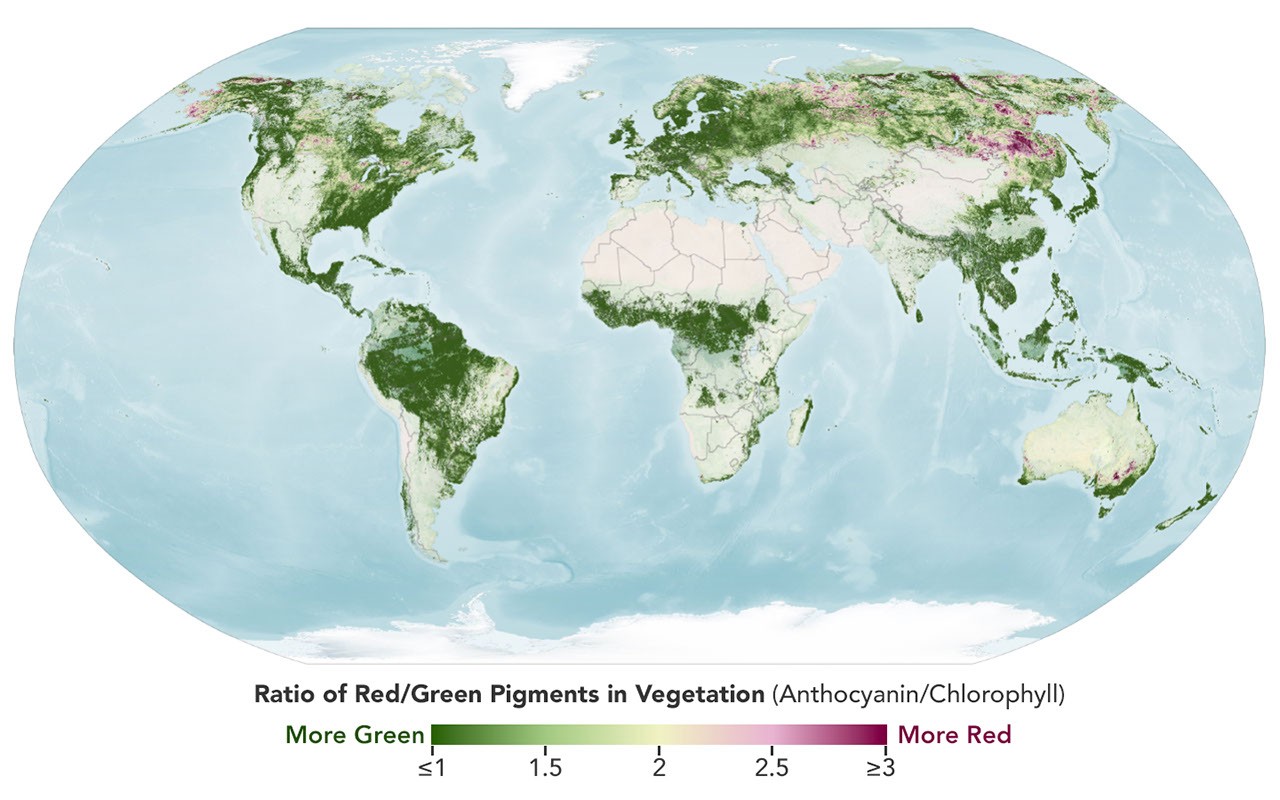
A recent analysis by NASA’s Earth Observatory has revealed the changing colors of foliage across various regions, highlighting significant areas of red vegetation from late September to early October 2026. The data, collected by the Ocean Color Instrument (OCI) on the PACE satellite, shows a notable transition in the vibrancy of leaves, with peaks of red observed in northern parts of the U.S., Canada, and Russia.
Shifting Colors Observed
The maps created from satellite observations illustrate the vegetation’s color spectrum, with dark green representing healthy leaves and dark red indicating the presence of pigments such as anthocyanins. During the week from September 29 to October 4, large patches of red were noted in Alaska, northern Canada, Mongolia, and Russia, with smaller regions in Australia also displaying red foliage. By October 5 to 11, the reddest areas had shifted southward, becoming more pronounced in the Mid-Atlantic, the U.S. Southeast, southern Russia, China, and Mongolia.
Understanding Foliage Changes
NASA scientists utilize the OCI’s capabilities to track changes in leaf pigments that signify fall colors. This satellite can measure variations in red, orange, and yellow hues, providing insights into where and when foliage color peaks. The analysis indicated that areas in northern and eastern Russia, as well as northern Alaska and Canada, exhibited particularly high levels of red foliage during the initial week of October.
Significance of Pigment Measurement
The ability to monitor these pigments continuously is crucial for understanding seasonal changes. As chlorophyll levels decrease with cooler temperatures and shorter days, other pigments become visible, leading to the vibrant fall colors. The satellite’s data allows researchers to examine how environmental factors impact leaf coloration, which is essential for broader ecological studies.
Community Engagement in Phenology
In addition to satellite data, the Global Learning and Observations to Benefit the Environment (GLOBE) program encourages public participation through its North American Phenology Campaign. Participants are invited to submit photographs of fall foliage, which will help validate and enhance satellite observations. This collaborative effort aims to improve understanding of how changes in vegetation color relate to ecological dynamics, including climate change and agricultural impacts.
NASA scientists emphasize the importance of ground observations to enrich satellite data. They are particularly interested in how various vegetation types respond to environmental changes, which could inform research on global carbon cycles and ecosystem health.
Source: NASA