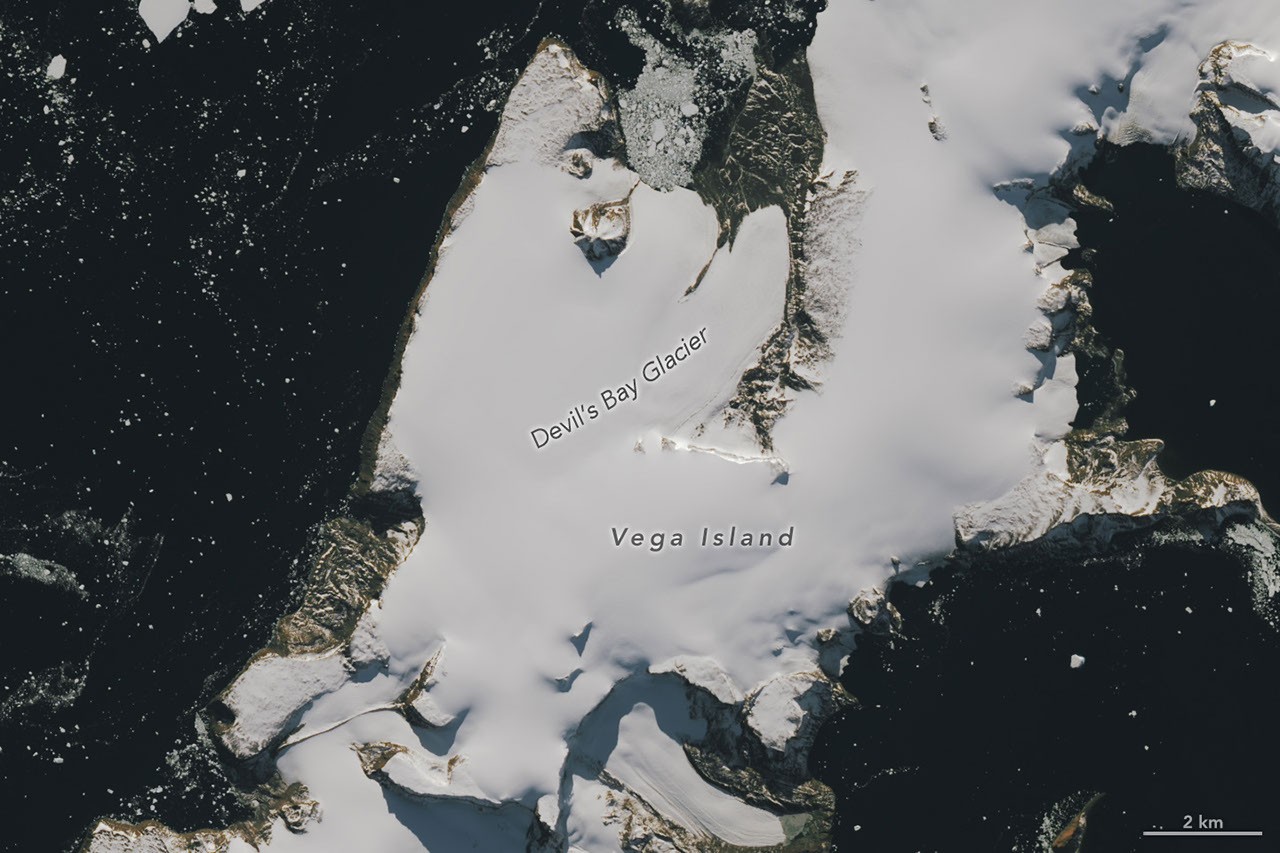
A portion of Vega Island in Antarctica has been captured in images resembling a grinning skull, as seen from space. The unique formation, created by the interplay of ice, rock outcrops, and glacial moraines, has drawn attention from scientists and observers alike.
Unusual Ice Formation
Located in the Weddell Sea, Vega Island appears to present a sinister visage, with its features resembling a skull looking towards nearby Devil Island. The images, taken by the Operational Land Imager on Landsat 9, show the island in two contrasting states: one during the typical snowy season in March 2025 and another in October 2026 when much of the snow had melted away, revealing dark ice surfaces.
Glaciologist Mauri Pelto noted that higher winter temperatures in 2026, particularly in June, contributed to the reduced snow cover on the island. The absence of snow has implications for the region’s glaciers, as less snow means less insulation for the ice beneath, potentially accelerating melting as temperatures continue to rise.
Impact of Climate Change
Pelto indicated that the darker bare ice absorbs more solar energy, which could lead to an intensified melting process as days lengthen and temperatures warm. He remarked that even a thin layer of new snow could help protect the glaciers in the short term, as snow cover preserves the ice from weathering. However, the exposed ice faces a risk of changing structure, which impacts its long-term stability.
The glacier known as Devil’s Bay Glacier has been under observation since the summer of 1998-1999, with findings showing a steady decline in its mass. Satellite imagery has revealed significant ice loss across Vega Island’s glaciers in recent decades, leading to increased visibility of bedrock in the area.
Historical Context
Vega Island has a notable history, particularly during the early 20th century. The Swedish Antarctic Expedition of 1901-1903 encountered severe challenges, including the loss of their ship to pack ice, resulting in a winter of isolation for the expedition members. The site of their reunion in 1903, near Cape Well-met, now marks a historical point of interest amidst the island’s eerie ice formations.
The images of Vega Island, taken by NASA’s Earth Observatory, serve as a stark reminder of the ongoing changes in polar environments and the broader impacts of climate change on glacier dynamics.
Source: NASA